ElectionChamp
Why Security Matters More in Union Elections
Union elections carry unique security concerns that go beyond typical organizational voting. The workplace setting creates pressures that don’t exist in an HOA or nonprofit election: employer interference, peer coercion, supervisory intimidation, and factional politics can all threaten election integrity. The LMRDA was passed specifically to address these risks.
A secure union election protects not just the integrity of the outcome but the rights of every individual member to vote their conscience without fear of retaliation.
The Secret Ballot: Your Most Important Protection
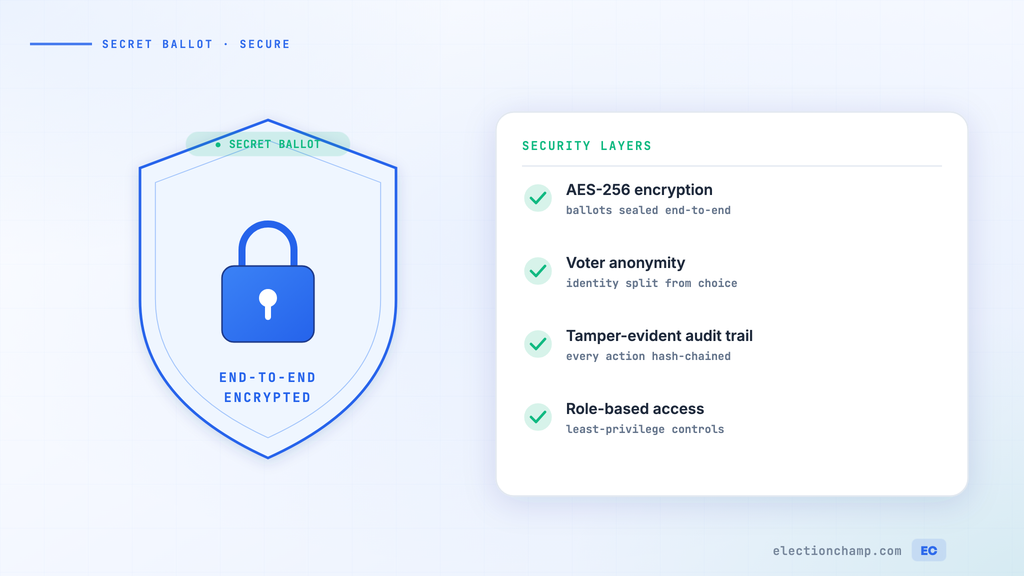
The LMRDA mandates secret ballot elections for local union officers. The secret ballot serves multiple purposes:
- Prevents employer retaliation: If management can’t know how a member voted, they can’t punish dissent
- Prevents peer coercion: Members can’t be pressured to prove how they voted
- Prevents factional intimidation: Opposing political groups within the union can’t target voters
- Preserves union solidarity: By keeping individual votes private, the union can unite behind the winner regardless of internal disagreements
How ElectionChamp Protects Ballot Secrecy
|
Security Layer |
How It Works |
What It Prevents |
|
Architectural separation |
Voter identity data and ballot selection data are stored in separate, unlinked systems |
Administrators or hackers linking a voter to their choices |
|
No ballot tagging |
Ballots carry no identifier that could be traced back to a voter |
Post-election identification of how any member voted |
|
Anonymous results |
Results show only aggregate counts — never individual ballots |
Anyone deducing individual votes from the results data |
|
Admin restrictions |
Even administrators can only see IF someone voted, never WHAT they voted |
Insider misuse of administrative access |
|
Last-5 masking |
During active elections, the 5 most recent voters’ status is hidden |
Real-time correlation of timing with identity |
Voter Authentication: One Member, One Vote
Preventing fraudulent or duplicate voting is critical for election legitimacy:
- Unique 16-digit keys: Each member receives a randomly generated, single-use key that cannot be guessed or duplicated
- One-time activation: Once a ballot is submitted, the key is permanently deactivated — no second votes, no vote changes
- Direct delivery: Keys are sent directly to each member’s email and/or phone — not distributed through intermediaries who might intercept them
- No shared access: There is no master password, group login, or shared ballot link that could allow unauthorized voting
Preventing Coercion and Intimidation
Even with a secret ballot, coercion is possible if members are pressured to vote in someone else’s presence or to show their screen. Safeguards include:
- Mobile privacy: Members can vote from their personal phone in any private location — a bathroom, their car, their home
- No confirmation of selections: The thank-you page confirms that a ballot was submitted but does not display what was voted for, so a screenshot cannot prove how someone voted
- Extended voting windows: With 7-14 day windows, no one can tell when a member voted, making “vote with me right now” pressure impractical
- Steward training: Educate stewards that they should never ask members to vote in their presence, share their screen, or disclose their selections
Protecting Against Employer Interference
The LMRDA and NLRA both prohibit employer interference in union elections. Online voting provides natural protections:
- Voting occurs outside the employer’s systems — no company email, no company network, no company devices required
- Employers cannot access the voting platform, see participation data, or view results
- Voting links go to members’ personal email/phones, not work addresses (unless the member prefers their work email)
- The ballot is accessible from any internet connection — members don’t need to use workplace WiFi
Audit Trails: Proving the Process Was Fair
The strongest defense against election fraud allegations is complete, tamper-evident documentation:
- ElectionChamp logs every administrative action: who accessed the dashboard, when voters were added or removed, when notifications were sent, when the election was opened or closed
- All logs include timestamps and cannot be edited or deleted by administrators
- Results are calculated automatically by the system — not by human counters who could make errors or be influenced
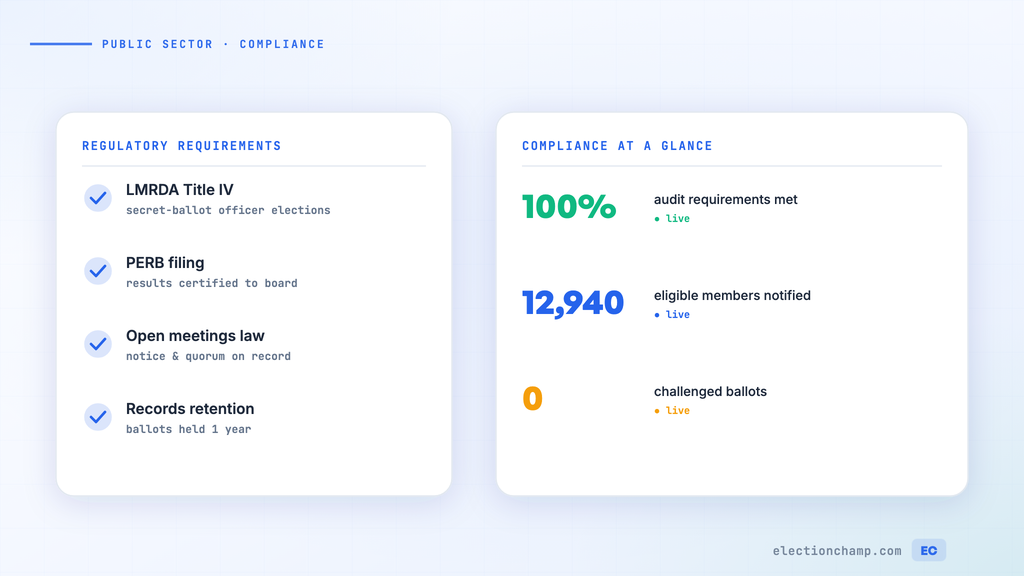
- The complete audit trail and results CSV can be downloaded and provided to OLMS, candidate observers, or any oversight body
Common Fraud Scenarios and How to Prevent Them
|
Fraud Scenario |
Prevention Measure |
ElectionChamp Feature |
|
Someone votes using another member’s key |
Keys sent directly to individual email/phone; members instructed not to share |
Unique single-use voter keys |
|
An administrator manipulates the results |
Results are calculated automatically; admin cannot modify vote tallies |
Automated counting + audit trail |
|
Extra ballots are added (ballot stuffing) |
Each voter key is linked to a specific member; Extra Keys require admin action to assign |
Closed voter list + audit trail |
|
Members are excluded from voting |
Full membership roster is imported; Any exclusion is logged |
Complete voter list import + audit log |
|
Voter is coerced to vote a certain way |
Anonymous ballot; private mobile voting; extended window |
Architectural anonymity + mobile access |
|
Results are selectively disclosed |
Result visibility can be locked until election closes |
“No One” result visibility setting |
Best Practices for Maximum Security
- Send voter keys directly to members — never through stewards, supervisors, or third parties
- Use both email and SMS delivery to ensure every member receives their key through at least one channel
- Set Result Visibility to “No One” until the election closes for the highest integrity
- Archive the complete audit trail and results CSV immediately after the election
- Train the Election Committee on security protocols before the election begins
- Communicate security measures to members — knowing the system is secure increases participation and trust
- Keep election records for at least 1 year (LMRDA minimum) and ideally for the full term of elected officers
Security as a Bargaining Asset
A union that runs verifiably secure elections demonstrates organizational competence and democratic legitimacy. This strength carries over to the bargaining table, to organizing campaigns, and to public perception. Members who trust their election process are more engaged, more unified, and more willing to stand together when it matters most.
Ready to modernize your organizational voting? Start for free at ElectionChamp.com — secure, anonymous, and mobile-friendly voting for every organization.