ElectionChamp
When Your Union’s Governing Documents Need Updating
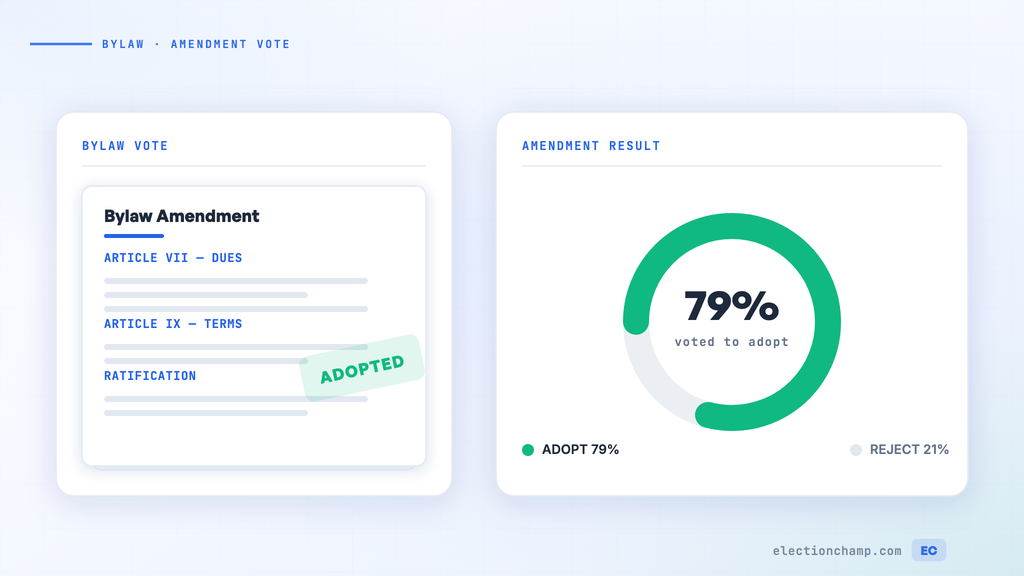
Union constitutions and bylaws are living documents. As workplaces change, industries evolve, and membership needs shift, these governing documents must be updated. Dues adjustments, structural reorganization, merger authorization, election procedure changes, and new member benefit provisions all require formal amendment processes.
But amending a constitution or bylaws is harder than a regular vote — it typically requires higher approval thresholds, longer notice periods, and broader member education. Online voting makes these demanding votes more accessible and better documented.
Types of Union Constitutional Changes
|
Amendment Type |
Common Examples |
Typical Threshold |
|
Bylaw amendments |
Dues changes, meeting schedule modifications, committee structure |
Simple majority or two-thirds of votes cast |
|
Constitutional amendments |
Structural changes, officer positions, eligibility rules |
Two-thirds of votes cast, or majority of total membership |
|
Charter modifications |
Local name changes, jurisdiction changes, affiliation changes |
Per international union requirements |
|
Merger/dissolution |
Combining with another local, dissolving the organization |
Two-thirds or three-quarters of total membership |
Phase 1: Preparation (60-30 Days Before Vote)
- Draft the amendment: Work with your constitution and bylaws committee or legal counsel to draft precise amendment language.
- Review procedural requirements: Your constitution specifies how amendments are proposed, noticed, and approved. Follow these procedures exactly.
- Determine the approval threshold: Identify whether you need a simple majority, two-thirds, three-quarters, or another threshold.
- Calculate the relevant base: Is the threshold based on votes cast, members present, or total membership? This determines your participation target.
Phase 2: Member Education (30-14 Days Before Vote)
- Distribute the full amendment text to all members — not just a summary
- Provide a plain-language explanation: “What this change means for you”
- Show a side-by-side comparison: current language vs. proposed language
- Explain why the change is needed — the problem it solves or the improvement it creates
- Host information sessions (in-person, virtual, or both) where members can ask questions
- Distribute a FAQ document addressing anticipated concerns
Phase 3: Setting Up the Vote
- Create the election in ElectionChamp with a clear name: “Proposed Amendment to Bylaw Article VII — Dues Structure”
- Build the ballot: Create a Yes/No question using Plurality voting. Word the question neutrally.
- Use the Voter Instructions field to include the full amendment text and plain-language summary directly on the ballot
- Leave “Who can see results while voting is open?” on “No one”
- Set the voting window: 7-14 days for routine amendments; consider longer for major constitutional changes
- Import the complete membership roster — every eligible member must have the opportunity to vote
Phase 4: The Vote
- Send notifications via email + SMS for maximum reach
- Time the launch to align with your constitutional notice period
- Send at least two reminders during the voting window
- Monitor participation closely — if the threshold is based on total membership, you need high turnout to pass
Phase 5: Results and Implementation
- Download results immediately after the vote closes
- Calculate whether the threshold was met: compare Yes votes against the required base (votes cast, members present, or total membership)
- Communicate the result to all members with exact numbers
- If approved: file the amendment with your international union (if required), update governing documents, and communicate the effective date
- If rejected: share the result, explain next steps, and consider whether to revise and resubmit
Multiple Amendments on One Ballot
Organizations often propose several amendments at once. Best practices:
- Vote on each amendment separately — members may support some but not others
- Create a separate ballot question in ElectionChamp for each proposed change
- Number and title each amendment clearly so members can track which is which
- If amendments are interdependent (Amendment B only makes sense if Amendment A passes), note this in the voter instructions
Notice Requirements: Getting It Right
|
Source |
Typical Notice Requirement |
How to Comply |
|
Your union’s constitution |
Varies — usually 15-30 days written notice to all members |
Send by mail AND email/SMS per your constitutional requirements |
|
LMRDA (if applicable) |
Reasonable notice of election/vote; 15 days for officer elections |
Follow constitutional requirements, which typically exceed LMRDA minimums |
|
International union |
May require approval before local vote or specific procedures |
Check with your international’s governance department |
|
State law |
Some states have specific requirements for union governance votes |
Consult legal counsel for state-specific rules |
Overcoming Participation Challenges
Amendment votes often face an apathy problem — members who are satisfied with the status quo don’t feel motivated to vote, while opponents are highly motivated. This can cause amendments to fail not on their merits but due to low turnout. Strategies:
- Frame the amendment in terms of member impact: “This change saves you $X” or “This change gives you Y new benefit”
- Connect the amendment to a real problem members have experienced: “Remember when we couldn’t hold elections during the plant shutdown? This amendment fixes that.”
- Use the participation rate as a motivation tool: “65% of members have voted — we need 75% for this to pass. Have you voted yet?”
- Mobilize stewards for personal outreach during the voting window
- Consider timing amendment votes alongside officer elections when turnout is naturally higher
Planning your next vote? Read about union voting software and contract ratification votes, or see pricing: free up to 20 voters, $10 up to 200, then $0.05 per voter.