ElectionChamp
Corporate Governance in the Digital Age
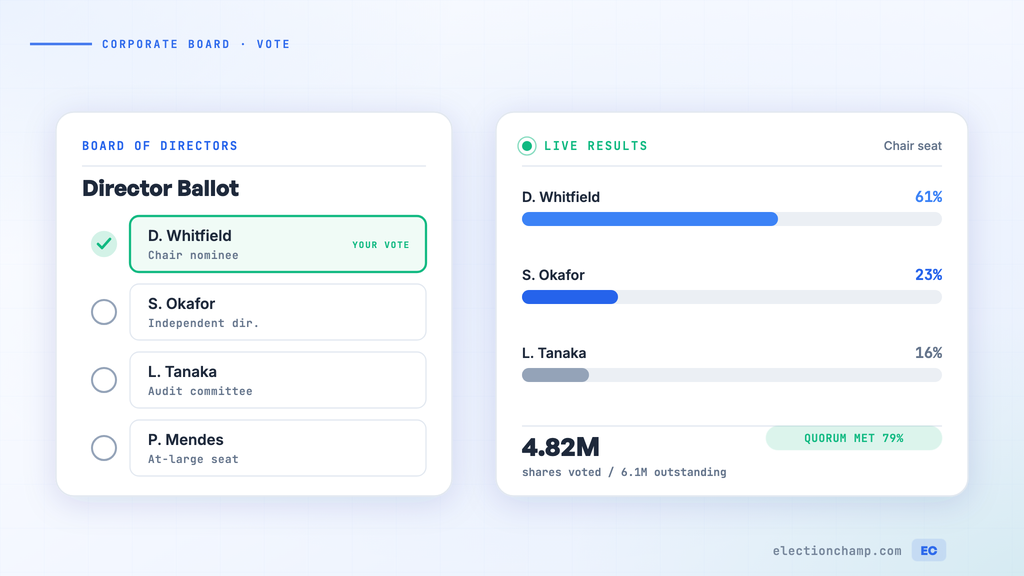
Corporate governance depends on effective decision-making processes. Board elections, shareholder resolutions, executive compensation approvals, merger votes, and policy decisions all require formal voting. Yet many businesses still rely on paper proxies mailed to shareholders, show-of-hands votes at meetings, or email chains that lack proper documentation.
Online voting brings the same efficiency, security, and transparency to corporate governance that businesses demand in every other aspect of their operations.
Types of Corporate Votes
|
Vote Type |
Who Votes |
Common Frequency |
Typical Threshold |
|
Board of Directors election |
Shareholders or members |
Annual |
Plurality or majority of quorum |
|
Officer elections |
Board of Directors |
Annual or as needed |
Majority of board |
|
Executive compensation (Say on Pay) |
Shareholders |
Annual (public companies) |
Advisory — no binding threshold |
|
Merger/acquisition approval |
Shareholders |
As needed |
Majority or supermajority of shares |
|
Bylaw amendments |
Shareholders or board |
As needed |
Per bylaws — often supermajority |
|
Special resolutions |
Shareholders |
As needed |
Per articles of incorporation |
|
Board committee decisions |
Committee members |
Ongoing |
Majority of committee |
|
Budget approvals |
Board of Directors |
Annual |
Majority of board |
Private Companies and Small Corporations
While public companies often use institutional proxy services, private companies, closely-held corporations, and smaller businesses have governance needs that are perfectly suited for platforms like ElectionChamp:
- Annual board elections where shareholders elect directors
- Board votes on major decisions (acquisitions, capital expenditures, executive hiring)
- Shareholder votes on bylaw amendments or corporate actions
- Advisory votes and straw polls to gauge stakeholder sentiment
- Written consent in lieu of meeting — formalized through online voting
The Proxy Problem
Traditional shareholder voting relies heavily on proxy statements mailed to shareholders, who either return a paper proxy card or attend the meeting in person. This process is:
- Expensive: Printing, mailing, and processing proxy materials costs $3-10+ per shareholder
- Slow: The mail cycle (send proxy, wait for return, process) takes 4-6 weeks minimum
- Low-participation: Proxy return rates for smaller companies often fall below 30%
- Error-prone: Paper proxies can be ambiguous, incorrectly marked, or lost in the mail
The Online Voting Solution
- Cost: ElectionChamp’s pricing starts free (up to 20 voters) and scales affordably — dramatically less than printing and mailing
- Speed: Set up in minutes, vote in days — the entire cycle completes in 1-2 weeks
- Participation: Online voting typically doubles or triples participation compared to paper proxies
- Accuracy: Digital ballots eliminate ambiguous marks and counting errors
- Documentation: Automatic audit trail, downloadable results, and verifiable records
Board-Level Voting
Boards of directors regularly vote on matters between annual meetings. Online voting facilitates these decisions:
- Board resolutions can be circulated and voted on digitally, creating a formal record
- Committee elections (audit committee chair, compensation committee members) can be conducted efficiently
- Strategic decisions requiring board approval (large contracts, new hires, policy changes) can be voted on without scheduling a special meeting
- Written consent in lieu of meeting — many corporate codes allow boards to act without a meeting if all directors consent in writing. An online vote formalizes this process.
Setting Up a Corporate Election
- Identify the voting population: Shareholders (for annual elections), board members (for board decisions), or specific stakeholders
- Review your articles of incorporation and bylaws for voting procedures, quorum requirements, and approval thresholds
- Create the election in ElectionChamp: Name it formally — “Acme Corp 2026 Annual Meeting — Director Election”
- Build the ballot with each position or resolution as a separate question. For director elections, use Plurality voting. For resolutions, use Yes/No.
- Import the voter list: Shareholders from your transfer records, or board members from your corporate secretary’s records
- For weighted voting (shares-based): If shareholders have unequal voting rights based on share ownership, use ElectionChamp’s weighted voting feature
- Set the voting window to align with your annual meeting schedule — typically 2-4 weeks of pre-meeting voting
- Launch and monitor participation through the dashboard
Annual Meeting Integration
Online voting complements your annual shareholder meeting:
- Open voting 2-4 weeks before the annual meeting to capture advance votes
- At the meeting, present the participation dashboard and preliminary results
- Allow meeting attendees who haven’t voted to cast ballots during the meeting
- Close voting at the conclusion of the meeting and certify results
- Distribute certified results to all shareholders via email
Legal Considerations
|
Consideration |
Details |
Action Required |
|
State corporate code |
Each state’s business corporation act governs shareholder voting procedures |
Review your state’s code for electronic voting provisions |
|
Articles of incorporation |
Your charter may specify voting procedures |
Verify online voting is authorized or amend articles |
|
Bylaws |
Bylaws typically detail election procedures |
Update bylaws to explicitly authorize electronic voting |
|
Record date |
Determine which shareholders are eligible to vote |
Set record date per bylaws; use that roster for voter list |
|
Quorum |
Minimum participation required for valid vote |
Monitor real-time on ElectionChamp dashboard |
|
Written consent |
Many states allow action without a meeting via written consent |
Online voting can serve as the consent mechanism |
Note: ElectionChamp is designed for organizational governance, not SEC-regulated public company proxy solicitation. For public companies subject to SEC proxy rules, consult with securities counsel about the appropriate platform.
Cost and Efficiency Comparison
|
Factor |
Traditional Paper/Proxy |
ElectionChamp Online |
|
Setup time |
4-6 weeks (design, print, mail) |
30-60 minutes |
|
Cost per voter (100 shareholders) |
$5-15 per shareholder |
$0.10 per voter |
|
Participation rate |
20-35% |
50-75% |
|
Result availability |
Days to weeks after meeting |
Instant upon close |
|
Audit trail |
Manual documentation |
Automatic, timestamped logs |
|
Environmental impact |
Paper, envelopes, postage |
Zero paper waste |
Planning your next vote? Read about online voting for businesses and polls, surveys, and motions, or see pricing: free up to 20 voters, $10 up to 200, then $0.05 per voter.