ElectionChamp
Beyond the Boardroom: Decisions Don’t Wait for Meetings
Boards of directors make dozens of decisions between formal meetings. Budget approvals, contract authorizations, executive compensation decisions, equity grants, and policy changes all require board action. Waiting for the next quarterly meeting to address urgent matters isn’t practical.
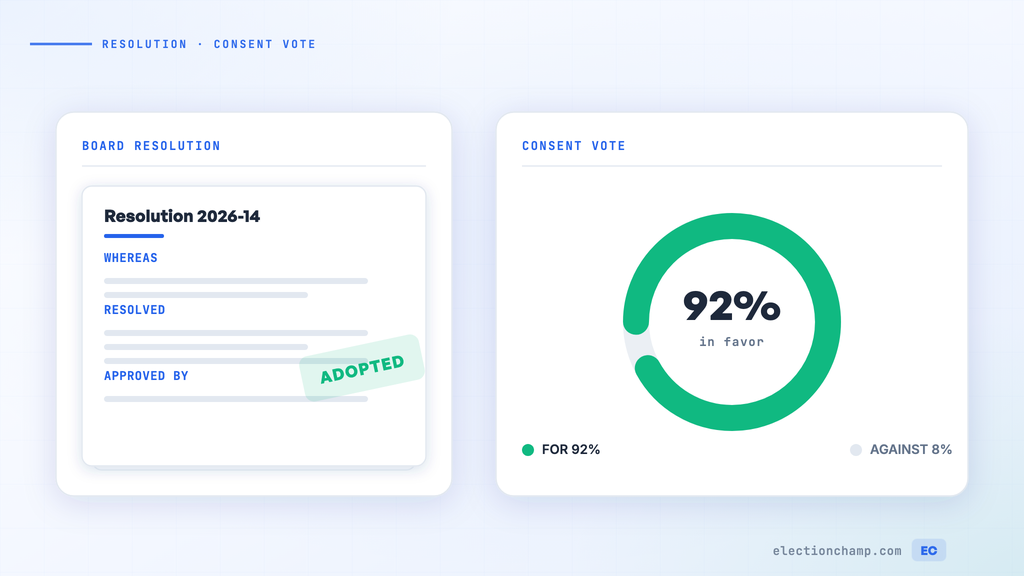
Written consent — where directors approve a resolution without convening a meeting — is the standard mechanism for between-meeting decisions. Moving this process online creates a faster, more documented, and legally stronger record than email chains and PDF signatures.
Written Consent vs. Meeting Votes
|
Factor |
Meeting Vote |
Written Consent (Traditional) |
Digital Consent Vote |
|
Process |
Convene meeting, discuss, vote |
Circulate resolution, collect signatures by email/fax |
Circulate resolution, vote online |
|
Speed |
Depends on scheduling |
Days to weeks (chasing signatures) |
Hours to days |
|
Documentation |
Meeting minutes |
Signed consent forms |
Automated results + audit trail |
|
Discussion |
Real-time debate |
Email threads (scattered) |
Pre-vote discussion period, then formal vote |
|
Legal validity |
Well-established |
Well-established (most states) |
Valid under ESIGN/UETA + state corporate codes |
|
Participation proof |
Attendance record |
Signatures (sometimes incomplete) |
Verifiable digital participation record |
Legal Framework for Digital Consent Votes
Digital board votes are legally valid in most jurisdictions, supported by:
- The Electronic Signatures in Global and National Commerce Act (ESIGN, 2000): Federal law that validates electronic signatures and records for commercial transactions including corporate governance
- The Uniform Electronic Transactions Act (UETA): Adopted by 49 states, provides that electronic records and signatures have the same legal effect as their paper equivalents
- State corporate codes: Most state business corporation acts specifically authorize action by written consent without a meeting, and modern interpretations include electronic methods
- Delaware General Corporation Law (DGCL §141(f)): Specifically permits board action by unanimous written consent “in writing or by electronic transmission”
Important: Check your specific state’s corporate code and your company’s articles of incorporation and bylaws to confirm that electronic voting is authorized. When in doubt, amend your bylaws to explicitly include electronic methods.
Phase 1: Draft the Resolution
- Write the resolution in standard format: “RESOLVED, that the Board of Directors of [Company Name] hereby approves [specific action].”
- Include recitals (“WHEREAS” clauses) that provide context and rationale for the action.
- Have legal counsel review resolutions for significant corporate actions (equity issuances, M&A, major contracts).
- Attach any supporting documents that directors need to review (financial projections, contract terms, executive profiles).
Phase 2: Set Up the Vote
- Create an election in ElectionChamp: Name it formally — “Board Resolution: Approval of Q2 2026 Operating Budget”
- Set the voter list to board members only.
- Create a Yes/No ballot question with the resolution text in the Voter Instructions.
- Enable Allow Abstain for directors who want to formally abstain.
- Set a short voting window: 3-5 business days for routine matters, 24-48 hours for urgent decisions.
- Send notifications via email (and SMS for urgency) to all directors.
Phase 3: Vote and Document
- Directors review the resolution and supporting materials at their convenience
- Each director submits their vote through the secure ballot
- Monitor participation through the dashboard — follow up individually with directors who haven’t voted
Phase 4: Certify and Archive
- Download the results CSV — it shows the vote of each question (Yes/No count, abstentions)
- Download the audit trail — timestamped record of all actions
- For unanimous consent requirements: all directors must vote Yes. Any No vote or non-response means the resolution fails without unanimous consent.
- File the results with your corporate records alongside the resolution text
Unanimous vs. Majority Consent
|
Consent Type |
When Required |
Implementation |
What Happens If Not Met |
|
Unanimous written consent |
Most state codes require unanimity for action without a meeting (e.g., Delaware DGCL §141(f)) |
All directors must vote Yes — one No vote or non-response = resolution fails |
Call a formal meeting to discuss and vote |
|
Majority consent |
Some bylaws or state laws permit majority written consent |
Resolution passes if more than half of all directors vote Yes |
Resolution fails — can be brought to a meeting |
|
Supermajority consent |
Per specific bylaw provisions for certain actions |
Resolution requires two-thirds or three-quarters of all directors |
Resolution fails — may need bylaw-level quorum |
Template Resolution Language
Here’s a standard format you can adapt for most board resolutions:
RESOLUTION OF THE BOARD OF DIRECTORS OF [COMPANY NAME]
Action by Written Consent Without a Meeting
WHEREAS, [context for the decision — why this action is being considered];
WHEREAS, [additional background if needed];
NOW, THEREFORE, BE IT RESOLVED, that the Board of Directors of [Company Name] hereby [specific action being approved, described with precision];
FURTHER RESOLVED, that [any additional actions, authorizations, or delegations];
FURTHER RESOLVED, that the officers of the Company are hereby authorized and directed to take any and all actions and to execute any and all documents necessary or advisable to carry out the intent and purposes of the foregoing resolutions.
Common Resolution Types
- Financial: Budget approvals, loan authorizations, bank account changes, dividend declarations
- Equity: Stock option grants, SAFE conversions, new share issuances, stock splits
- Personnel: Executive hiring, compensation changes, severance approvals, key person designations
- Contracts: Major vendor agreements, leases, partnership agreements above threshold amounts
- Governance: Committee appointments, bylaw amendments, policy adoptions, officer elections
- Strategic: Market entry decisions, product line changes, acquisition approvals, divestitures
Best Practices
- Maintain a resolution register: A chronological log of all board resolutions, including date, subject, vote result, and filing location
- Number your resolutions: “Resolution 2026-01” through “Resolution 2026-XX” for easy reference
- Set a regular cadence: Monthly resolution batches for routine matters keep governance current
- Differentiate urgency: Routine resolutions get 5-day windows; time-sensitive matters get 24-48 hours with SMS notification
- Archive comprehensively: Resolution text + supporting documents + ElectionChamp results CSV + audit trail = complete record
Planning your next vote? Read about online voting for businesses and polls, surveys, and motions, or see pricing: free up to 20 voters, $10 up to 200, then $0.05 per voter.