ElectionChamp
Governance at Scale: The PE/VC Challenge
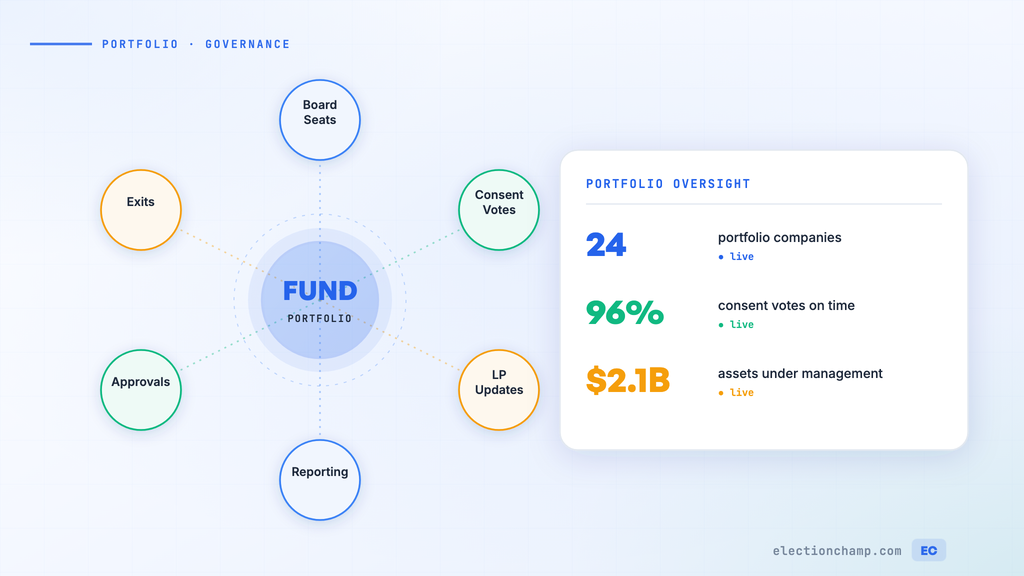
Private equity and venture capital firms don’t manage one board — they manage many. A mid-sized PE firm might sit on 8-15 portfolio company boards simultaneously. A VC firm with a mature portfolio could have board seats across 20+ companies at various stages. Each board requires regular resolutions, consent solicitations, and formal votes.
Managing this volume of governance activity through email chains, DocuSign roundups, and ad hoc processes is inefficient and creates compliance risk. Online voting standardizes and streamlines the process across the entire portfolio.
Types of PE/VC Governance Votes
|
Vote Type |
Who Votes |
Typical Frequency |
Common Threshold |
|
Board resolutions |
Directors (including PE/VC representatives) |
Monthly or as needed |
Majority of board |
|
Written consents |
Directors |
As needed |
Unanimous or majority (per charter) |
|
LP advisory committee votes |
Advisory committee members |
Quarterly or as needed |
Majority of committee |
|
Investor consent solicitations |
Shareholders/investors |
As needed for major actions |
Per investment agreement |
|
Fund-level decisions |
Limited partners |
Annual or as needed |
Per LPA terms |
|
Annual meeting elections |
Portfolio company shareholders |
Annual |
Per company bylaws |
Standardizing Governance Across the Portfolio
One of the biggest advantages of online voting for PE/VC firms is process standardization:
- Every portfolio company board vote follows the same format and documentation standard
- Board resolutions are created, voted on, and archived consistently regardless of which company they concern
- The firm’s governance team can manage all votes from one platform rather than juggling different processes per company
- Audit trails are uniform — critical for LP reporting and regulatory compliance
Board Resolution Voting
Board resolutions are the bread and butter of PE/VC governance. Common resolutions that benefit from formal voting:
- Approving annual budgets and operating plans
- Authorizing equity issuances (stock options, SAFE conversions, new rounds)
- Approving major contracts, leases, or capital expenditures above threshold amounts
- Executive compensation decisions (hiring, firing, bonus approvals)
- Strategic decisions (pivots, new product lines, market entry)
- M&A activity (acquisitions, divestitures, mergers)
Setting Up Board Resolution Votes
- Create a vote in ElectionChamp for each resolution: Include the full resolution text in the Voter Instructions field.
- Set the voter list to the board of directors only — typically 3-7 people.
- Use Yes/No Plurality voting. For written consents requiring unanimity, any “No” vote means the resolution fails.
- Set a 3-5 day voting window. Board members are busy, but resolutions shouldn’t linger.
- Download the results and audit trail — file with the company’s corporate records.
LP Advisory Committee Votes
Fund-level advisory committees advise on conflicts of interest, valuation matters, and fund extension requests:
- Create a separate election for each advisory committee matter
- Import the advisory committee member list as voters
- Provide complete documentation in the Voter Instructions field — LPAC members need full context
- Leave “Who can see results while voting is open?” on “No one” to prevent early results from influencing remaining voters
Investor Consent Solicitations
Certain actions require consent from investors or specific shareholder classes:
- Amendment to investment agreements or fund terms
- Key person changes
- Fund extensions or modifications
- Conflicts of interest approvals
ElectionChamp’s weighted voting feature can handle share-based or commitment-based voting power differences among investors.
Documentation and Compliance Benefits
|
Requirement |
Traditional Process |
Online Voting Process |
|
Record keeping |
Email chains, scattered PDFs, DocuSign envelopes |
Centralized, downloadable CSV and audit trail |
|
Proof of approval |
Forwarded emails, “I think we approved that” |
Timestamped vote records with individual participation data |
|
LP reporting |
Manual compilation from various sources |
Standardized records across all portfolio companies |
|
Regulatory compliance |
Depends on who saved what |
Automatic, consistent documentation |
|
Due diligence readiness |
Scramble to compile records |
All governance records in one downloadable archive |
Multi-Portfolio Dashboard Approach
For firms managing multiple portfolio company boards, a systematic approach maximizes efficiency:
- Use consistent naming conventions: “[Portfolio Co Name] — [Resolution Type] — [Date]”
- Create a governance calendar tracking when each portfolio company’s board votes are scheduled
- Designate a governance coordinator who manages all votes across the portfolio
- Archive results by portfolio company in a structured folder system
- Include governance metrics (participation rates, resolution outcomes) in quarterly LP reports
Planning your next vote? Read about online voting for businesses and polls, surveys, and motions, or see pricing: free up to 20 voters, $10 up to 200, then $0.05 per voter.