ElectionChamp
The Engagement Crisis Hiding in Plain Sight
Despite decades of research, employee engagement remains stubbornly low. Surveys consistently show that a significant portion of the workforce feels disengaged — going through the motions without feeling connected to their organization’s direction or decisions. The cost is enormous: higher turnover, lower productivity, more absenteeism, and weaker customer outcomes.
Many organizations try to solve this with perks, ping-pong tables, and pizza parties. But the research points to something more fundamental: people want to have a voice. They want to influence the decisions that affect their daily work life. Structured online voting provides that voice in a scalable, documented, and fair way.
The Research: Why Voice Matters
Decades of organizational behavior research support the connection between employee voice and positive outcomes:
- Participative management: Involving employees in decisions that affect them leads to higher job satisfaction, organizational commitment, and performance
- Procedural justice: When people perceive that decision-making processes are fair (even if the outcome isn’t what they wanted), they’re more satisfied and committed
- Self-determination theory: People have fundamental needs for autonomy, competence, and relatedness. Having a voice in workplace decisions satisfies the autonomy need
- The IKEA effect: People value outcomes more when they’ve contributed to creating them. A policy that employees helped shape gets more buy-in than one imposed from above
Where Employee Voting Makes the Biggest Impact
|
Decision Area |
Impact on Engagement |
Example Votes |
|
Work environment |
Very High — directly affects daily experience |
Office layout, temperature policy, noise rules, remote work schedule |
|
Benefits & perks |
High — signals company values employee preferences |
Health plan selection, wellness programs, commuter benefits |
|
Recognition & culture |
High — builds community and belonging |
Employee of the Month, team awards, company values |
|
Scheduling & policies |
High — affects work-life balance |
Meeting-free days, core hours, PTO policies |
|
Professional development |
Medium — shows investment in growth |
Training budget allocation, conference selection, mentorship programs |
|
Social & events |
Medium — builds team bonds |
Offsite activities, holiday party format, charitable giving |
|
Tools & technology |
Medium — affects daily productivity |
Project management tool, communication platform, equipment choices |
The Engagement-Retention Connection
Employee voice doesn’t just improve engagement metrics — it directly impacts retention:
- Feeling heard reduces frustration: When employees can influence decisions rather than just complain about them, frustration decreases and problem-solving increases.
- Voting creates ownership: An employee who voted on the team’s flexible work policy feels ownership over that policy — they’re less likely to leave because of it.
- Participation builds community: Regular voting on shared decisions creates a sense of belonging. Employees feel like stakeholders, not just workers.
- Transparency builds trust: When organizations openly share how decisions are made and what employees think, trust deepens.
- Fair processes matter more than favorable outcomes: Employees who voted for the losing option are still more satisfied than employees who were never asked.
Phase 1: Start Small (Month 1-2)
- Begin with a low-stakes, fun vote: team outing activity, office snack selection, or company book club pick
- Use ElectionChamp’s anonymous voting so employees can vote honestly without social pressure
- Share results transparently and act on them immediately — this builds trust in the process
Phase 2: Expand Scope (Month 3-6)
- Add meaningful decisions: benefits preferences, scheduling policies, tool selection
- Establish a regular cadence: monthly or quarterly votes on topics that matter
- Communicate that results are advisory or binding — and follow through consistently
Phase 3: Institutionalize (Month 6+)
- Employee voting becomes part of how the organization makes decisions
- Major policy changes include a voting component as standard practice
- Annual engagement surveys include questions about whether employees feel heard — track improvement
- New employees learn about the voting culture during onboarding
Measuring Impact
|
Metric |
How to Measure |
What to Look For |
|
Voting participation rate |
ElectionChamp dashboard — total votes / total eligible |
Increasing trend over time; target 70%+ |
|
Employee engagement scores |
Annual or quarterly engagement survey |
Improvement in “I feel my voice matters” and similar items |
|
Voluntary turnover rate |
HR data — resignations / headcount |
Decrease after voting culture is established |
|
Policy satisfaction |
Follow-up surveys after voted policies are implemented |
Higher satisfaction for voted policies vs. top-down ones |
|
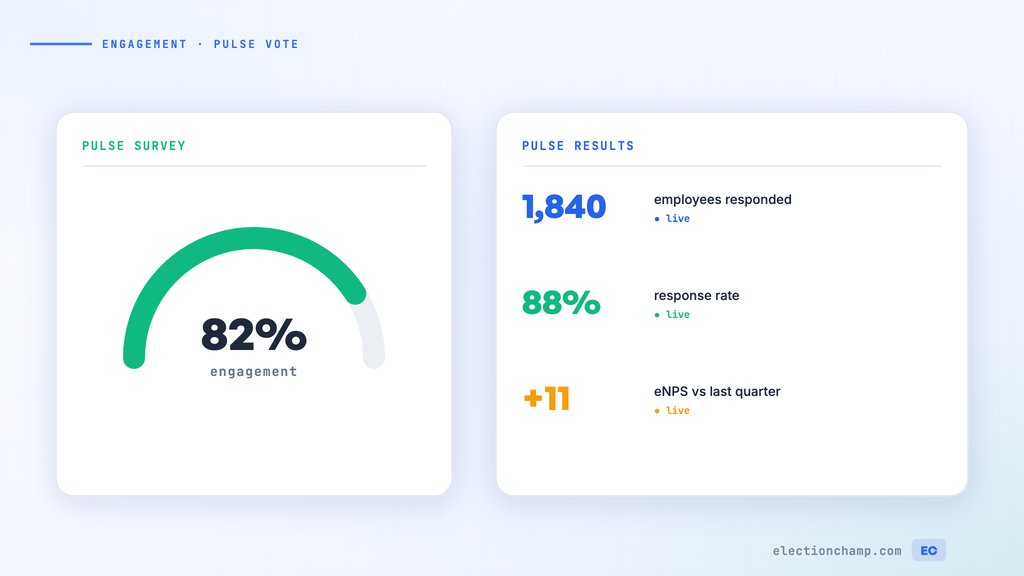
eNPS (Employee Net Promoter Score) |
Regular pulse surveys |
Improvement correlated with voting frequency |
What NOT to Vote On
Not every decision should be democratic. Voting works poorly for:
- Individual personnel decisions: Hiring, firing, promotions, and compensation should be based on merit and professional judgment, not popularity
- Technical or expert decisions: Whether to use React or Angular should be decided by engineers, not the whole company
- Decisions you’ve already made: Holding a vote when the outcome is predetermined destroys trust faster than never asking
- Decisions that create winners and losers among employees: Avoid votes that could divide the team along personal lines
- Urgent operational decisions: When speed matters, act first and seek input afterward
Planning your next vote? Read about online voting for businesses and polls, surveys, and motions, or see pricing: free up to 20 voters, $10 up to 200, then $0.05 per voter.