ElectionChamp
Why Ratification Participation Matters
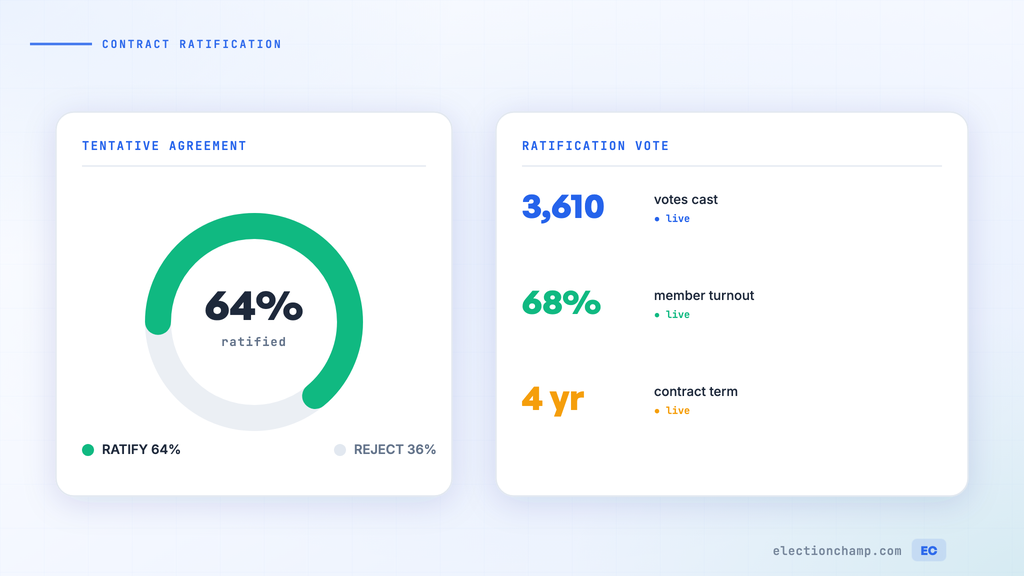
Contract ratification votes are among the most consequential decisions a union makes. The collective bargaining agreement (CBA) defines wages, benefits, working conditions, grievance procedures, and employment security for every member. When a negotiating committee brings a tentative agreement back to the membership, the ratification vote determines whether those terms become binding.
Yet ratification votes often suffer from the same turnout problems as officer elections — sometimes worse. Members who are satisfied with the agreement may not bother to vote, while those opposed are highly motivated. This creates a distortion where a minority of members can reject a deal that the majority would accept, sending negotiators back to the table unnecessarily.
High participation in ratification votes ensures the outcome reflects the genuine will of the membership.
Before Negotiations Conclude
- Prepare your membership list: Ensure email and phone contact information is current for all members
- Communicate the negotiation timeline: Keep members informed about when they should expect a tentative agreement
- Set expectations: Tell members how the ratification process will work — they’ll receive a ballot link via email/SMS
When a Tentative Agreement Is Reached
- Draft a clear contract summary: Don’t expect members to read the full CBA. Create a plain-language summary of key changes — wages, health insurance, retirement, work rules, contract duration.
- Prepare a side-by-side comparison: Show current terms vs. proposed terms for the most impactful provisions.
- Identify what the union gained and what it conceded: Be transparent. Members who feel informed vote with more confidence.
- Set up the ratification vote immediately: Speed matters. Members are most engaged right after a TA is announced.
Setting Up the Ratification Ballot
Ratification votes are straightforward in ElectionChamp:
- Create a new election: Name it clearly — “CBA Ratification Vote: 2026-2029 Contract”
- Set a short voting window: 3-7 days. Unlike board elections, ratification votes benefit from urgency.
- Build the ballot: Create a single Yes/No question using Plurality voting
- Write the question clearly: give the ballot item a short title of up to 60 characters, such as “2026 Tentative Agreement”, and put the full question in the Voter instructions: “Do you approve the tentative agreement between [Union Local] and [Employer] dated [date]?”
- Include the contract summary in Voter Instructions: Members should be able to review key terms directly on the ballot page
- Leave “Who can see results while voting is open?” on “No one” so early results don’t influence later voters
- Enable Allow Abstain for members who want to participate but are undecided
- Import your full membership list and send notifications via email + SMS
Reaching Every Member
Contract ratification requires broad participation to be legitimate. Use every available channel:
Shift Workers
- SMS notifications are critical — many shift workers check texts but not email during work hours
- Set voting windows that span multiple shifts — a 5-day window ensures every rotation has time to vote
- Have stewards distribute printed keys at shift changes for members without smartphones
- Post voting reminders in break rooms, locker rooms, and on union bulletin boards
Remote or Traveling Members
- Mobile voting means members can vote from any location with cell service
- Send reminders that voting takes less than 2 minutes from a phone
- For members in areas with limited connectivity, provide printed keys they can use when they reach a connection
Members on Leave
- Members on medical leave, parental leave, or other approved absence are still voting members
- Ensure their contact information is current in the voter list
- Consider a personal call from the steward to inform them about the vote
Communicating About the Agreement
How you communicate about the tentative agreement directly affects participation and the vote outcome:
|
Communication |
Timing |
Content |
|
Initial Announcement |
Immediately after TA |
“We have a tentative agreement. Here’s what it includes. Ratification vote opening [date].” |
|
Detailed Summary |
Same day or next day |
Side-by-side comparison of current vs. proposed terms |
|
Member Information Session |
1-2 days after TA |
Town hall or worksite meetings where negotiators explain the deal and answer questions |
|
Ballot Notification |
Voting opens |
Automatic via ElectionChamp — includes ballot link and contract summary |
|
Reminder 1 |
Day 2-3 |
“Haven’t voted yet? Here’s what your fellow members are asking about the agreement.” |
|
Final Reminder |
24 hours before close |
“Last chance to have your say on the contract. Vote now.” |
If the Contract Is Ratified
- Announce the result immediately to all members via email and at worksites
- Communicate the effective date and implementation timeline
- Begin implementing new terms on the agreed-upon date
- Archive the vote results and audit trail for the duration of the contract
If the Contract Is Rejected
- Communicate the result transparently — share the vote count, not just the outcome
- Solicit feedback: What provisions drove the rejection? Use a follow-up survey.
- Reconvene the bargaining committee with clear direction from the membership
- Return to negotiations with the employer
- When a new TA is reached, repeat the ratification process
Multi-Unit and Multi-Employer Ratifications
Some unions negotiate agreements covering members at multiple worksites or with multiple employers:
- Create separate elections for each bargaining unit if agreements differ
- Use Voter Labels to identify members by worksite, shift, or employer
- If a master agreement covers all units, a single election with one ballot question works
- Report results by unit if your bylaws require unit-level ratification thresholds
Planning your next vote? Read about union voting software and contract ratification votes, or see pricing: free up to 20 voters, $10 up to 200, then $0.05 per voter.