ElectionChamp
Short answer: Usually yes. An incorporated nonprofit needs a board of directors under state law in nearly every case. The minimum size depends on your state: California and Delaware allow one director, while New York, Texas, Florida, and Illinois set the floor at three. The IRS sets no minimum, but Form 990 asks how many voting board members you have and how many are independent.
Below is the statute text for six states, checked October 2026, plus officer rules, who elects the board, term limits, and how to run the election. Confirm with your bylaws and counsel before you rely on any rule here.
Nonprofit Board Requirements Under State Law and the IRS
State nonprofit corporation laws put a board in charge. California says it plainly: “Each corporation shall have a board of directors” (Corp. Code 5210). Delaware, where nonprofits form as nonstock corporations, says every corporation’s affairs “shall be managed by or under the direction of a board of directors” (8 Del. C. 141(a)).
The board does not have to run daily operations. California lets it delegate management to staff or a management company, as long as the work happens under the board’s direction.
Unincorporated Associations and Trusts
The corporate statutes in this post apply to incorporated nonprofits. An unincorporated association runs under its own constitution or bylaws, and a charitable trust is run by its trustees. Your governing documents decide who governs.
Both can still seek tax exemption. The Instructions for Form 1023 (revised December 2024) say an applicant must be “a corporation, limited liability company, unincorporated association, or trust.” Sole proprietorships, partnerships, and loosely affiliated groups of individuals are not eligible. If your group is unincorporated, ask counsel about personal liability before you treat a board as optional.
What the IRS Asks About Your Board
Board size comes from state law. The IRS sets no minimum, but its forms ask who governs you and how independent they are.
- Form 1023, Part I, line 9: the full names, titles, and mailing addresses of your officers, directors, and/or trustees.
- Form 1023, Part V: whether you pay officers, directors, or trustees, and whether they have business ties to organizations you deal with. A conflict of interest policy is not required for exemption; the instructions include a sample in Appendix A.
- Form 990, Part VI, lines 1a and 1b: the number of voting members of your governing body at year end, and how many are independent.
- Form 990, Part VI, line 2: whether any officer, director, trustee, or key employee has a family or business relationship with another.
- Form 990, Part VI, lines 8a and 8b: whether you documented meetings of the governing body and its authorized committees at the time they happened.
These governance questions sit on the full Form 990 (2025). The form notes that its policy section “requests information about policies not required by the Internal Revenue Code.” A board that meets on schedule and keeps minutes answers all of it easily.
How Many Board Members Does a Nonprofit Need?
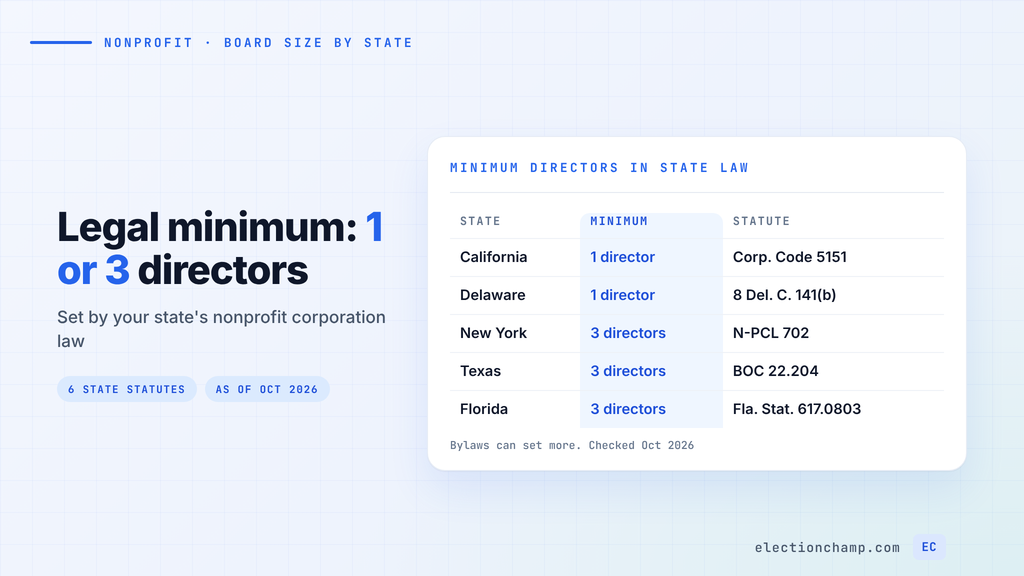
The legal minimum is one or three in every state we checked. Your bylaws can set a higher number or a range. Here is the statute text as of October 2026.
| State | Minimum directors | What the statute adds | Source |
|---|---|---|---|
| California | 1 | “The number or minimum number of directors may be one or more” | Corp. Code 5151(a) |
| Delaware | 1 | Each director must be a natural person | 8 Del. C. 141(b) |
| New York | 3 | The board is three if the bylaws do not fix another number | N-PCL 702(a) |
| Texas | 3 | Applies “if the corporation has a board of directors” | BOC 22.204(a) |
| Florida | 3 | The corporation “must never have fewer than three directors” | Fla. Stat. 617.0803 |
| Illinois | 3 | A bylaw range must start at 3 or more and span no more than 5 seats | 805 ILCS 105/108.10 |
If your state is not listed, check its nonprofit corporation act before you set a number.
Why Three Is the Practical Minimum
Even where one director is legal, a board of three or more is easier to run.
- Officer separation. California bars the secretary, treasurer, or CFO from also serving as president or board chair. Texas and New York bar one person from holding both president and secretary. You need at least two people to fill the offices.
- Paid founders. In California, no more than 49% of directors may be “interested persons”: anyone the corporation paid for services in the past 12 months, plus certain relatives (Corp. Code 5227). Reasonable director fees do not count. A paid founder needs at least two unpaid, unrelated directors alongside them.
- Tie votes. An odd number of seats avoids deadlock on a two-way split.
- Absences. On a two-person board, one missed meeting can leave the board unable to act.
Can a Nonprofit Have No Board?
Usually not, if it is incorporated. Two of the six states we checked have an explicit way around the standard board.
- Texas: The certificate of formation may vest management in the members (BOC 22.202(a)). Without that provision, the board manages the corporation.
- Delaware: A nonstock corporation’s certificate may provide that its affairs are managed “in a manner different from” the board model in section 141 (141(j)).
- California and New York: We found no such option. California says each corporation shall have a board, and New York requires at least three directors.
- Unincorporated groups and trusts: Your constitution or trust document decides who governs.
A one-director board is the closest option in California and Delaware. In California, that sole director cannot be paid for services, because one paid director out of one breaks the 49% rule.
Required Nonprofit Officers
Officers run the organization day to day under the board’s direction. Some states name the offices and limit who can hold them together.
| State | Required officers | Restriction | Source |
|---|---|---|---|
| California | Chair or president (or both), secretary, and treasurer or CFO (or both) | Secretary, treasurer, or CFO may not also be president or chair | Corp. Code 5213 |
| New York | Elected or appointed by the board | President and secretary must be different people; an employee may chair the board only with a supermajority board vote and written reasons | N-PCL 713 |
| Texas | President and secretary | President and secretary must be different people | BOC 22.231 |
| Illinois | Whatever the bylaws provide | None in the statute | 805 ILCS 105/108.50 |
Write each office’s duties into your bylaws. At minimum, say who chairs meetings, who keeps minutes and records, and who reports on finances. The minutes matter for Form 990, line 8a.
Member vs Non-Member Nonprofits: Who Elects the Board
Legal members are people with voting rights under your governing documents. Donors and newsletter subscribers are not members unless your bylaws make them members.
Member Nonprofits
Members elect the directors, usually at an annual meeting or by ballot. Your bylaws set who qualifies, the notice period, quorum, and the voting method. Clubs, parent groups, and professional associations often use this model.
Non-Member Nonprofits
The board elects its own successors. This is often called a self-perpetuating board.
- California: A corporation has no members unless its articles or bylaws provide for them. Any action that would need member approval then needs only board approval (Corp. Code 5310).
- New York: A charitable corporation may have no members if its certificate or bylaws say so (N-PCL 601(a)).
- Texas: A nonprofit is presumed to have members unless its certificate of formation says otherwise (Texas Secretary of State FAQ). If the governing documents are silent on how directors are chosen, the board elects them (BOC 22.206).
Settle which type you are before you plan an election. The answer decides who gets a ballot.
Nonprofit Board Term Limits
State statutes cap how long a single term can run. None of the sections we read limits how many terms a director can serve. Term limits come from your bylaws.
| State | Default term | Maximum term | Source |
|---|---|---|---|
| California | 1 year | 4 years; 6 years if the corporation has no members | Corp. Code 5220(a) |
| New York | 1 year | 5 years, or the number of classes on a classified board | N-PCL 703(b) |
| Texas | Until the next annual election | Set by the certificate or bylaws | BOC 22.208 |
| Illinois | Until the next election meeting, unless staggered | Not set in the statute | 805 ILCS 105/108.10(c) |
Staggered terms keep experience on the board. Illinois, New York, and Florida (617.0806) let you divide directors into classes. Florida’s statute and Texas’s default rule also keep a director in office until a successor qualifies, so a missed election does not empty the board.
Sample bylaw language: “Directors serve staggered three-year terms. No director may serve more than two consecutive full terms. A former director becomes eligible again after one year off the board.” A three-year term fits under every statutory cap in the table.
How to Run a Nonprofit Board Election
- Confirm who votes. Members vote in a member nonprofit; directors vote in a non-member one. Check whether your bylaws allow electronic or mail ballots, and confirm with your bylaws and counsel.
- List the open seats. Note which terms expire, which class each seat belongs to, and any vacancies.
- Collect nominations. Set a deadline and ask for a short candidate statement. Our nominating committee guide covers a fair process.
- Send notice. Follow the notice period in your bylaws and state law.
- Build the ballot. Use “select up to” for multi-seat races, add candidate bios, and allow abstain if your bylaws permit it.
- Vote by secret ballot when the race is contested. It protects voters and reduces disputes afterward.
- Record and report. Put the results in the minutes. Then update your bank signers and any state filing that lists directors.
For member elections, online voting reaches people who skip the annual meeting. In ElectionChamp, each voter gets a single-use 16-character key by email or SMS. Ballots are anonymous: administrators see who voted, never how. The audit log exports as a CSV for your records.
A board-only vote with 20 or fewer voters is free, and a 500-member election costs $25. See how nonprofit online voting works, or follow our guide to running fair nonprofit board elections online.
Frequently Asked Questions
Can a nonprofit have only one board member?
In some states. California and Delaware allow a one-director board. New York, Florida, and Illinois require at least three, and so does Texas when the corporation has a board. In California, a sole director cannot be paid for services because of the 49% interested persons rule.
Can a nonprofit board member be an employee?
Generally yes, within limits. California caps interested persons, including anyone paid for services in the past 12 months, at 49% of the board. New York lets an employee chair the board only with a supermajority board vote and written reasons. Check your state law and conflict of interest policy.
Does the IRS require a nonprofit to have a board?
The IRS sets no minimum board size. Form 1023 asks for the names of your officers, directors, and/or trustees. Full Form 990 filers report how many voting members the governing body has and how many are independent. State law decides whether you need a board and how big it must be.
Who elects the board of a nonprofit with no members?
The board elects its own successors. In California, a corporation without members needs only board approval for actions that would otherwise need member approval. In Texas, the board elects directors when the certificate of formation and bylaws do not say otherwise.
Planning your next vote? Read about nonprofit online voting and board elections, or see pricing: free up to 20 voters, $10 up to 200, then $0.05 per voter.