ElectionChamp
Why Union Election Compliance Is Non-Negotiable
Union elections operate under one of the most rigorous regulatory frameworks of any organizational election. The Labor-Management Reporting and Disclosure Act of 1959 (LMRDA), also known as the Landrum-Griffin Act, establishes detailed requirements for how unions must conduct officer elections. The Department of Labor’s Office of Labor-Management Standards (OLMS) actively enforces these requirements and can order new elections when violations occur.
For union officers, understanding and following these rules isn’t optional — it’s a legal obligation. Elections that violate LMRDA provisions can be challenged by any member, investigated by OLMS, and ultimately re-run under DOL supervision at the union’s expense. This guide covers everything union officers need to know to run compliant elections.
LMRDA Title IV: The Foundation of Union Election Law
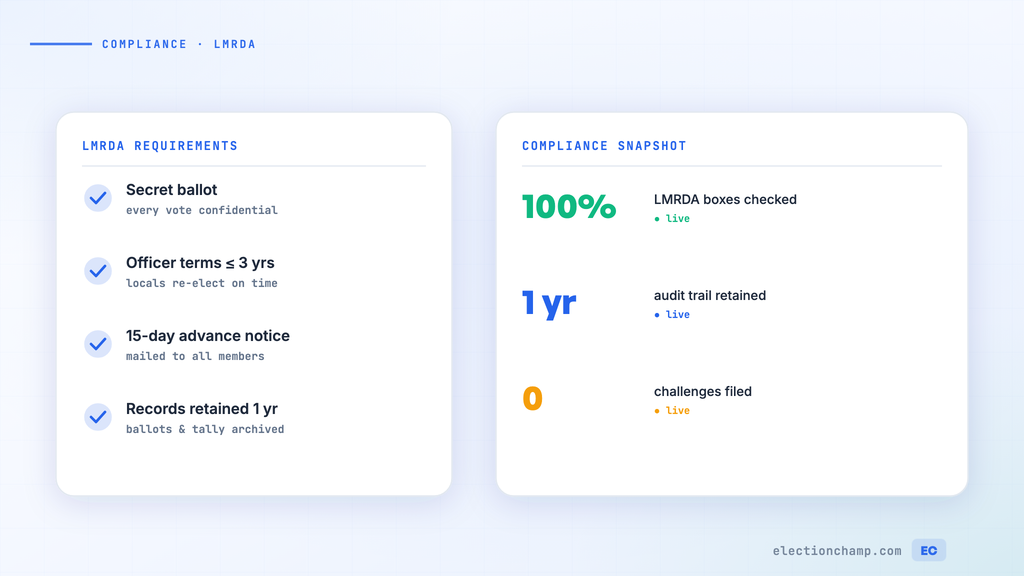
Title IV of the LMRDA (29 U.S.C. §§ 481-484) establishes the core requirements for union officer elections:
Election Frequency
|
Union Level |
Maximum Term |
Election Frequency |
|
Local unions |
3 years |
At least every 3 years |
|
Intermediate bodies (joint councils, conferences) |
4 years |
At least every 4 years |
|
National/International unions |
5 years |
At least every 5 years |
Secret Ballot Requirements
The LMRDA requires secret ballot elections for local union officers. This means:
- Each member’s vote must be confidential — no one can determine how any individual voted
- The voting method must prevent any link between the voter’s identity and their ballot selections
- ElectionChamp fully satisfies this requirement: ballots are anonymized by design, and even administrators cannot see how any voter voted
Candidate Rights Under the LMRDA
- Every member in good standing has the right to nominate candidates and to be a candidate (subject to reasonable qualifications)
- Candidates may have observers present at vote counting
- Each candidate must be treated equally — no favoritism in ballot position, communication access, or resources
- Union funds and employer resources cannot be used to promote any candidate
- Candidates must have access to membership lists (or the union must distribute campaign materials on request)
Member Voting Rights
- Every member in good standing has the right to vote in officer elections
- Reasonable qualifications for voting (e.g., minimum membership period) are permitted, but they must not be used to disenfranchise large segments of the membership
- No member may be required to pay a fee specifically to vote (though general dues requirements are acceptable)
- Absentee voting must be allowed where the union’s constitution or bylaws provide for it
Notice Requirements
The LMRDA requires that election notices be mailed to every member’s last known address at least 15 days before the election. Key details:
- The notice must specify the date, time, and place of the election (or the voting method and window for online elections)
- Notice must be sent to every member — not just those in good standing or those who regularly attend meetings
- Email notice alone may not satisfy the LMRDA’s “mailed” requirement — consult with your attorney about whether electronic notice supplements or replaces physical mail in your jurisdiction
- The notice should include information about nomination procedures if nominations haven’t yet closed
Electronic Voting and the LMRDA
The DOL’s OLMS has issued guidance on electronic voting for union elections. While the LMRDA was written before electronic voting existed, OLMS has generally accepted electronic methods that meet the act’s underlying requirements:
- Secret ballot: The system must ensure voter anonymity — ElectionChamp’s architectural separation of voter identity and ballot data satisfies this
- One member, one vote: Each member must be able to vote exactly once — ElectionChamp’s unique single-use voter keys prevent duplicate voting
- Equal access: All members must have a reasonable opportunity to vote — provide printed keys for members without email or internet access
- Observer access: Candidate observers should be able to verify the election’s integrity — ElectionChamp’s audit trail provides this transparency
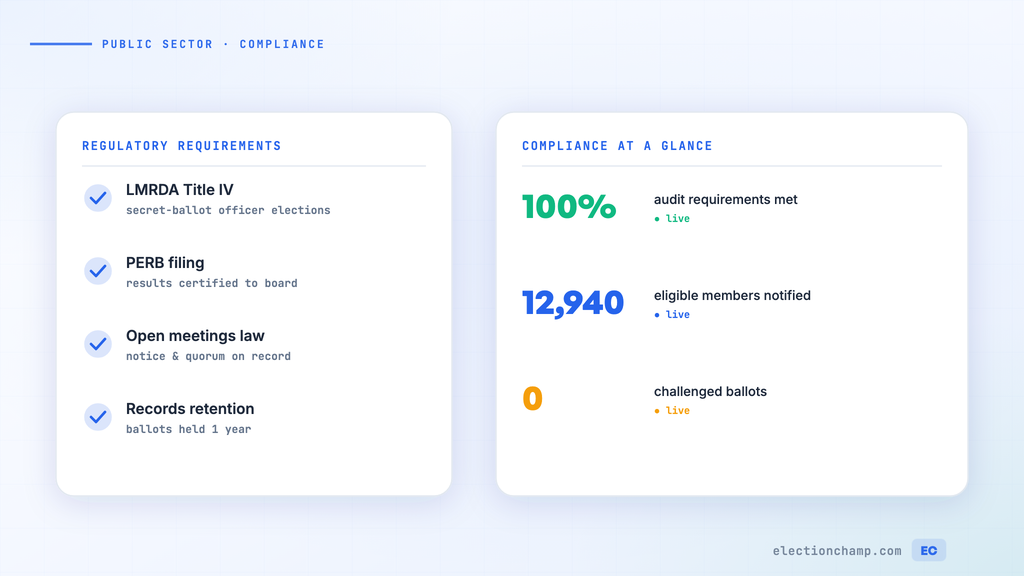
- Record preservation: Election records must be preserved for at least one year — archive ElectionChamp results and audit logs
Important: While OLMS has generally accepted electronic voting, the specific acceptability depends on how the election is conducted. Unions should ensure their constitution and bylaws authorize electronic voting and should maintain adequate records to demonstrate compliance.
Phase 1: Pre-Election (90-60 Days Before)
- Review your union’s constitution and bylaws for election procedures
- Appoint an Election Committee (members who are not candidates)
- Establish the election timeline, ensuring all LMRDA deadlines are met
- Prepare the membership roll — verify eligibility of all potential voters
Phase 2: Nominations (60-30 Days Before)
- Open nominations per your constitution’s procedures (meeting, petition, or both)
- Accept all nominations from members in good standing who meet reasonable qualifications
- Verify candidate eligibility promptly and communicate any disqualifications with the basis for the decision
- If your bylaws permit write-in candidates, plan for them now. ElectionChamp has no write-in line on election questions, so collect names with a nomination question first and list every nominee on the ballot
Phase 3: Campaign Period (30-15 Days Before)
- Distribute candidate information equally — ElectionChamp’s ballot profile feature ensures each candidate gets the same presentation
- Ensure no union funds are used to support or oppose any candidate
- Honor candidate requests to distribute campaign literature to the membership
- Ensure the membership list is available to all candidates equally
Phase 4: Election
- Mail election notices at least 15 days before the election opens (supplementing with email/SMS for faster delivery)
- Set up the election in ElectionChamp with all officer positions as separate ballot questions
- Import the complete membership roll as the voter list — do not exclude any member in good standing
- Generate printed keys for members who need a non-electronic option
- Launch the election and monitor participation through the dashboard
- Allow candidate observers to review the process (share dashboard access or audit trail as appropriate)
Post-Election Requirements
|
Requirement |
Details |
Timeline |
|
Announce results |
Communicate to all members, not just meeting attendees |
Immediately after close |
|
Preserve records |
All election records including ballots, tally sheets, and credentials |
Minimum 1 year (LMRDA requirement) |
|
Install officers |
New officers take office per constitution’s provisions |
Per constitution |
|
Report to DOL |
Include election information in LM-2/LM-3 annual report |
Next annual filing |
|
Handle protests |
Any member may file a protest; address internal complaints first |
Within the union’s timeframe, then DOL |
Handling Election Protests
Under the LMRDA, any union member may challenge an election. The process is:
- Internal remedy first: The member must exhaust the union’s internal complaint procedures (typically within 3 months of the election)
- DOL complaint: If the internal remedy doesn’t resolve the issue, the member may file a complaint with OLMS within 1 month of exhausting internal remedies
- OLMS investigation: OLMS investigates and determines whether a violation occurred that may have affected the outcome
- Court action: If OLMS finds a violation, it can file suit in federal court to set aside the election and conduct a new one under DOL supervision
The best defense against election protests is meticulous compliance and thorough documentation. ElectionChamp’s audit trail, which logs every administrative action with timestamps, provides critical evidence in any protest proceeding.
Planning your next vote? Read about union voting software and contract ratification votes, or see pricing: free up to 20 voters, $10 up to 200, then $0.05 per voter.