ElectionChamp
Short answer: To make a motion, wait for the chair to recognize you, then say “I move that…” followed by one specific proposal. Another member says “Second.” The chair restates the motion, opens debate, handles any amendments, and puts it to a vote. Under Robert’s Rules, most motions pass with a majority of the votes cast, and the chair announces whether the motion is adopted or lost.
How to Make a Motion: 8 Steps Under Robert’s Rules
The scripts below come from parliamentarian Jim Slaughter’s guide, Handling of a Motion, based on the 12th edition of Robert’s Rules of Order Newly Revised (RONR).
- Obtain the floor. When no one else has the floor, address the chair by title (“Madam President” or “Mr. Chair”) and wait to be recognized.
- State the motion. Say “I move that…” and name one action: “I move that the collective spend up to $500 on studio rental for the spring showcase.”
- Get a second. Another member says “Second.” The seconder does not need to be recognized first.
- The chair states the question. “It is moved and seconded that the collective spend up to $500 on studio rental for the spring showcase.” From here the motion belongs to the assembly.
- Debate. The mover speaks first. Then the chair favors members who have not yet spoken and alternates for and against when possible.
- Amend if needed. Members can propose wording changes before the vote (see below).
- The chair puts the question. “The question is on the adoption of the motion that… Those in favor, say aye. Those opposed, say no.” A member who doubts a voice vote can call “Division” to force a rising vote.
- The chair announces the result. “The ayes have it and the motion is adopted,” or “The noes have it and the motion is lost.”
A majority means more than half of the votes cast. The official Robert’s Rules FAQ calls “50 percent plus one” an error: a 9 to 8 vote passes (RONR 12th ed. 44:1). A tie is not more than half, so a tied motion is lost.
The minutes record the exact wording, the mover, and the result. Our board meeting minutes template has a vote block for each motion.
How to Second a Motion
Say “Second” or “I second the motion.” You do not need to stand or wait for recognition. A second does not commit you to voting yes. Per a Lamar University summary of Robert’s Rules, it “merely implies that the seconder agrees that the motion should come before the assembly and not that he/she is in favor of the motion.”
If nobody seconds, the chair says “The motion is not before you at this time” and moves on. No vote was taken, so the motion was not defeated.
Small boards may skip seconds. Slaughter’s Parliamentary Motions Guide notes that “some more formal requirements, like seconds to motions, may not apply in smaller boards or any size committee.” The official FAQ puts a small board at about a dozen members or fewer present.
How to Amend a Motion
An amendment changes a pending motion’s wording before the vote. C. Alan Jennings, PRP, lists the forms in his guide to amending a motion:
- Insert or add: “I move to amend by adding ‘on two Saturdays’ at the end.”
- Strike out: “I move to amend by striking out the word ‘spring.'”
- Strike out and insert: “I move to amend by striking out ‘$500’ and inserting ‘$750.'”
- Substitute: a strike-and-insert that replaces a paragraph or the whole motion.
An amendment needs a second, is debatable, and passes by majority vote even when the main motion needs two-thirds. It must be germane, meaning related to the motion. An amendment that just reverses the motion, such as changing “spend” to “not spend,” is out of order.
Primary and Secondary Amendments
A primary amendment changes the main motion. A secondary amendment changes the primary amendment. Jennings notes that “only one amendment to an amendment can be considered at any one time,” and Robert’s Rules stops at that second level.
Votes run in reverse order, most recent first:
| Vote | Question | If Adopted |
|---|---|---|
| 1st | Secondary: strike “$750,” insert “$600” | Primary now reads $600 |
| 2nd | Primary, as amended: strike “$500,” insert “$600” | Main motion now reads $600 |
| 3rd | Main motion, as amended | Collective spends up to $600 |
Friendly Amendments
A “friendly” amendment still needs the assembly’s approval. The official FAQ says that once the chair states a motion, “it is no longer the property of the mover, but of the assembly.” The chair can ask, “Is there any objection?” If none, the change is made. One objection sends it to debate and a vote (RONR 12th ed. 12:91).
How to Withdraw a Motion
Timing decides who controls the motion, per a University of Wisconsin Extension FAQ on withdrawing motions:
- Before the chair states it: the mover can withdraw or reword it alone.
- After the chair states it: the mover asks permission, granted by unanimous consent or, if someone objects, a majority vote.
Mover: “Mr. Chair, I ask permission to withdraw my motion.” Chair: “If there is no objection, the motion is withdrawn.” After a pause: “Hearing none, the motion is withdrawn.” Richard Hayes, PRP, covers this request in a National Association of Parliamentarians training on classes of motions. Some local government handbooks also require the seconder’s consent, so check your own rules.
Common Motions Chart: Second, Debate, Amend, Vote
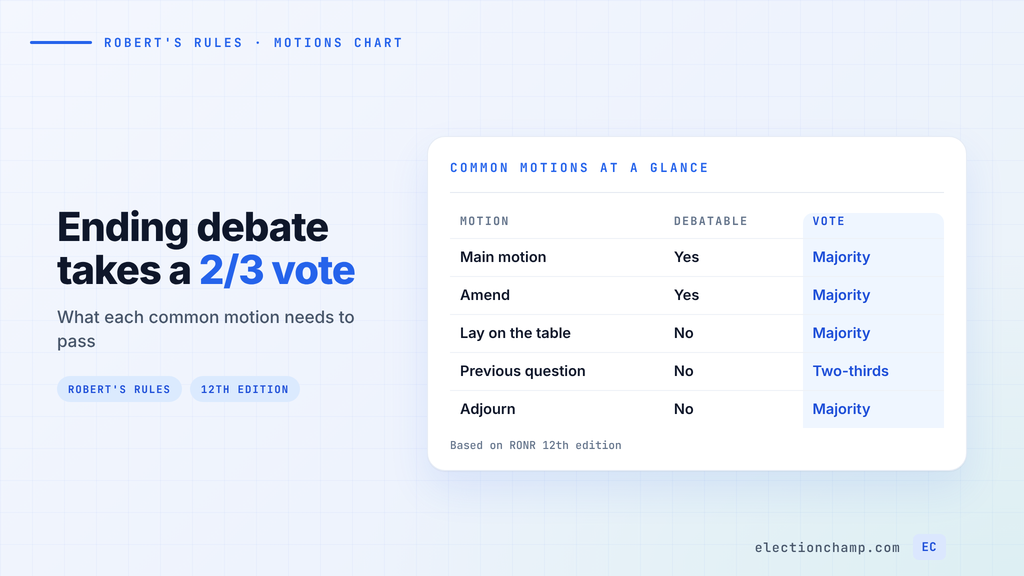
These rows come from Slaughter’s Parliamentary Motions Guide (RONR 12th edition).
| Motion | What to Say | Second | Debatable | Amendable | Vote |
|---|---|---|---|---|---|
| Main motion | “I move that…” | Yes | Yes | Yes | Majority |
| Amend | “I move to amend the motion by…” | Yes | Yes | Yes | Majority |
| Refer to a committee | “I move to refer the motion to…” | Yes | Yes | Yes | Majority |
| Postpone to a set time | “I move to postpone the motion to…” | Yes | Yes | Yes | Majority |
| Postpone indefinitely | “I move that the motion be postponed indefinitely” | Yes | Yes | No | Majority |
| Lay on the table | “I move to lay the question on the table” | Yes | No | No | Majority |
| Previous question (end debate) | “I move the previous question” | Yes | No | No | Two-thirds |
| Adjourn | “I move to adjourn” | Yes | No | No | Majority |
The official FAQ corrects these common mistakes:
- Shouting “Call the question” does not end debate. A member must be recognized, move the previous question, and get a second. It then needs two-thirds or unanimous consent (RONR 12th ed. 16:6 to 16:7).
- Tabling cannot kill a motion. That use “is not in order, because it would permit debate to be suppressed by a majority vote.” To delay, postpone to a set time. To drop it, postpone indefinitely.
- Two-thirds means at least two-thirds. Yes votes must be at least double the no votes, so 67 of 101 falls short (RONR 12th ed. 44:3).
How Motions Work in Online and Between-Meeting Votes
The official FAQ allows board meetings by videoconference only if the bylaws authorize them and everyone can hear each other at once. Collecting approvals one member at a time is not valid board action. Our guide to board resolutions and consent votes covers the alternatives.
The authors’ Sample Rules for Electronic Meetings have members post motions in writing, and one version treats an anonymous vote through the meeting service as a ballot vote. Our post on Robert’s Rules for online voting goes deeper.
A membership vote between meetings, by email or online ballot, is valid only where your bylaws or a statute allow it. Confirm with your bylaws and counsel. There is no floor, so nobody seconds or amends during the vote. Decide in advance who can put a motion on the ballot, usually the board.
To run one on ElectionChamp:
- Settle the wording first. Circulate the draft, set a deadline for proposed amendments, and decide them before launch. The ballot locks once voting opens.
- Add each motion as its own question. A motion question gives voters yes, no, and abstain. One ballot can hold several motions alongside an officer race.
- Publish the threshold. State in the voter instructions whether the motion needs a majority or two-thirds of votes cast.
- Close and record. Results are instant at close, with abstentions shown separately. Export the results CSV and audit log for the minutes.
ElectionChamp ballots are anonymous: administrators see who voted, never how. If your bylaws require a recorded roll call, take that vote in a meeting. See how motion votes are set up, or how bylaw votes work when your amendment clause sets its own notice and threshold.
Frequently Asked Questions
What happens if a motion is not seconded?
The chair announces that the motion is not before the meeting and moves on. No vote was taken, so the motion was not defeated. Small boards that relax the formal rules may not require seconds.
Can you vote against a motion you seconded?
Yes. A second only signals that the motion should come before the meeting. The seconder is free to speak and vote against it.
Can the chair make a motion?
In a small board, yes. The official Robert’s Rules FAQ lets the chair make motions and vote where no more than about a dozen board members are present. In larger meetings, check your bylaws.
What does “motion carried” mean?
The motion received the vote it needed and is adopted. A motion that falls short, including a tie, is lost.
Planning your next vote? Read about motion votes and bylaw votes, or see pricing: free up to 20 voters, $10 up to 200, then $0.05 per voter.