ElectionChamp
Government Agencies Need Voting Too — Just Not for What You Think
When people hear “government voting,” they think of public elections — presidential races, congressional votes, ballot measures. Those elections are administered by election commissions with their own specialized systems and regulatory frameworks. That’s not what this guide is about.
This guide covers the other kind of government voting: the internal elections, advisory votes, and committee selections that government agencies conduct as organizations. Federal departments, state agencies, county offices, municipal governments, school districts, and public authorities all have internal governance needs that online voting can serve.
Internal Government Votes That Benefit from Online Voting
|
Vote Type |
Who Votes |
Frequency |
Current Method |
|
Employee advisory committee elections |
Agency employees |
Annual |
Paper ballots or show of hands |
|
Union steward/rep elections |
Unionized employees |
Annual |
Meeting-based voting |
|
Employee recognition awards |
All staff |
Monthly/quarterly |
Email polls or nomination forms |
|
Policy advisory input |
Employees or citizen advisory board |
As needed |
Comment periods or meetings |
|
Task force and committee selection |
Department staff |
As needed |
Manager appointment (not democratic) |
|
Wellness/benefits advisory votes |
All employees |
Annual |
Surveys without formal voting structure |
|
Internal governance boards |
Board/commission members |
Regular |
In-person meeting votes |
|
Citizen advisory board elections |
Community members |
Annual |
Meeting attendance required |
Security Requirements for Government Use
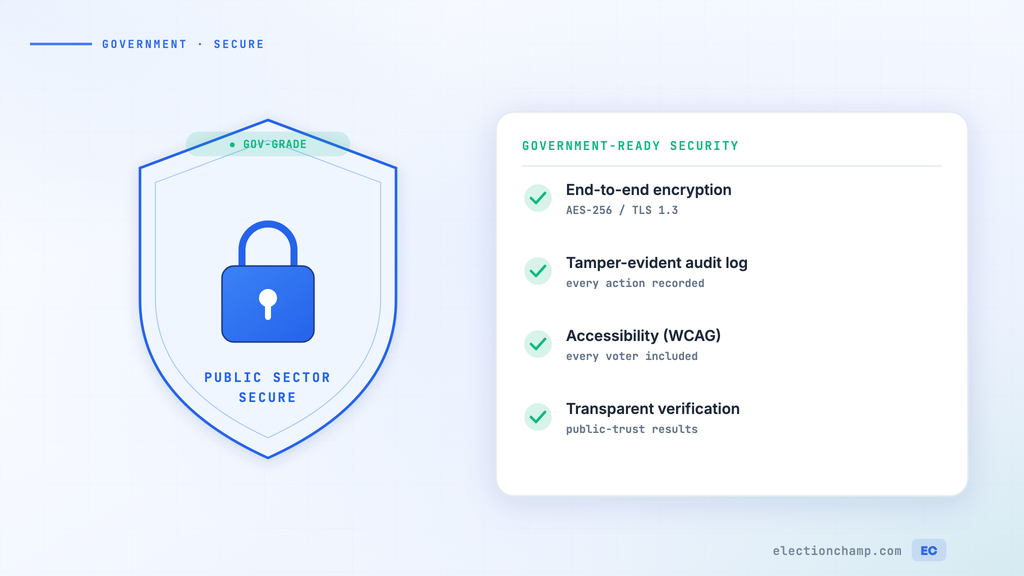
Government agencies operate under heightened security expectations. An online voting platform used by a government organization must meet or exceed these standards:
- Encryption: AES-256 for data at rest and SSL/TLS for data in transit — the same standards government systems use for sensitive data
- Access control: Only authorized administrators can manage elections. Role-based access prevents unauthorized changes.
- Authentication: Unique, single-use voter keys for each participant. No shared access or reusable credentials.
- Anonymity: For personnel-related votes (employee committees, union reps, recognition awards), ballot secrecy protects employees from retaliation.
- Audit trail: Government organizations are subject to transparency and record-keeping requirements. Complete, timestamped audit trails satisfy these obligations.
- Data handling: Government employee data is sensitive. The platform should not use voter data for any purpose beyond the election.
Use Case: Employee Advisory Committee Elections
Many government agencies have employee advisory committees — groups that provide input on workplace policies, benefits, safety, and morale. These committees are typically elected by their peers:
- Create the election: “[Agency Name] Employee Advisory Committee Election 2026”
- Build the ballot: List candidates by department or at-large. Use Plurality voting with the number of winners matching committee seats.
- Import the eligible voter list: All permanent employees in the relevant bargaining unit or classification.
- Enable Email + SMS: Government employees are often away from desks — SMS ensures they receive the notification.
- Set a 7-10 day voting window: Government work schedules include shifts, field work, and leave — a generous window ensures everyone can participate.
- Archive results with your agency’s records: Downloadable CSV and audit trail meet documentation requirements.
Use Case: Citizen Advisory Boards
Municipalities and counties often have citizen advisory boards for parks, planning, public safety, arts, and other policy areas. When these boards have elected members:
- Import eligible community members as voters (from registration rolls or board membership lists)
- Include candidate statements on the ballot so voters can learn about each nominee
- Use a 14-day voting window to accommodate diverse community schedules
- Provide Manual Keys at city hall and community centers for residents without internet access
- Send results to the appointing authority and publish on the city website for transparency
Procurement and Budget Considerations
Government agencies operate under procurement rules that affect technology adoption:
- ElectionChamp’s pay-per-election model avoids the complexity of annual contracts and subscription procurement. Each election is a discrete, low-dollar purchase.
- For elections under 20 voters (many committee elections), the platform is free — no procurement required.
- For larger elections, the cost ($10-50 for most government internal elections) often falls below micro-purchase thresholds, simplifying procurement.
- No long-term commitment: Each election is independent. No annual subscription to justify or renew.
Open Records and Transparency
Government organizations may be subject to open records laws (FOIA, state public records acts). Important distinctions:
- Election administration records (audit trail, participation data, communication records) are generally responsive to open records requests
- Individual ballot selections are anonymous and cannot be produced — the system doesn’t maintain linkable records
- Aggregate results (vote totals, percentages, winners) are public records and should be shared transparently
- ElectionChamp’s architectural anonymity protects individual voters even if election records are subject to public disclosure
Why Government Agencies Choose ElectionChamp
- Security that meets government standards: AES-256, SSL/TLS, unique voter keys, anonymous ballots, complete audit trail
- No procurement complexity: Pay-per-election at low cost, often below micro-purchase thresholds. Free for ≤20 voters.
- No software to install: Browser-based — works within government IT environments without software approval processes
- Accessibility: Mobile-optimized for field workers, shift workers, and remote employees. Manual Keys for offline access.
- Documentation: Downloadable records satisfy government record-keeping requirements
Ready to modernize your organizational voting? Start for free at ElectionChamp.com — secure, anonymous, and mobile-friendly voting for every organization.