ElectionChamp
Governance Isn’t Just for Big Companies
In the early stages, startups are focused on building product, finding market fit, and surviving. Governance feels like a corporate luxury — something to worry about later. But governance gaps created early become expensive problems later: muddled board records, unclear voting rights, undocumented decisions, and investors who question your operational maturity.
Good governance doesn’t require bureaucracy. It requires clear processes and proper documentation — things that take minutes to set up but protect the company for years.
When Startups Need Formal Board Votes
|
Decision |
Why a Formal Vote Matters |
When This Typically Starts |
|
Approving fundraising rounds |
Investors require board approval before close |
Seed round or Series A |
|
Issuing equity (options, shares) |
Legal requirement under most corporate codes |
First employee hire |
|
Approving annual budget |
Board oversight responsibility |
Post-seed, when spending increases |
|
Executive hiring and compensation |
Board approval required for C-suite hires |
First executive hire beyond founders |
|
Major contracts |
Board approval for commitments above a threshold |
When contracts become material |
|
Pivots and strategy changes |
Investors and directors should formally approve |
When direction significantly changes |
|
M&A and partnerships |
Legal and fiduciary requirements |
Any acquisition or significant partnership |
Board Composition and Voting Rights
Understanding who votes and how is essential:
Typical Startup Board Structure
- Founders’ seats: Controlled by the founding team — typically 1-2 seats
- Investor seats: Allocated to lead investors in each funding round — typically 1-2 seats
- Independent seats: Neutral directors added as the company matures — 0-1 seat initially
- Observer seats: Non-voting seats sometimes given to smaller investors or advisors
Voting Power
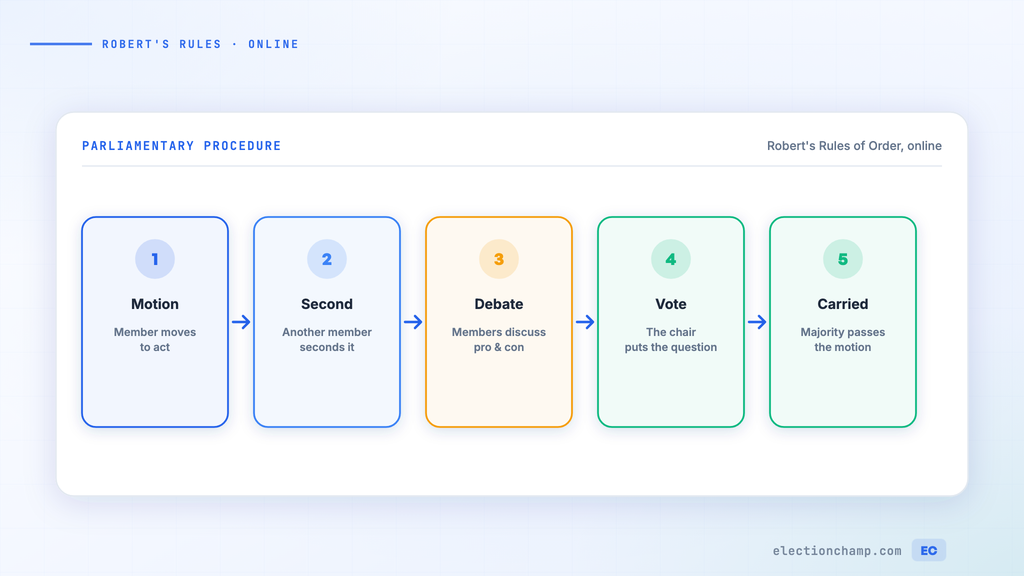
- Board decisions typically require a simple majority of directors
- Some decisions (issuing new shares, changing the charter, M&A) may require supermajority or specific class approval
- Protective provisions in investment agreements may give investors veto power over specific actions
- These voting rights should be clearly documented in your board’s governance framework
Using Online Voting for Board Resolutions
Most startup board decisions happen via unanimous written consent (UWC) — a legal mechanism that allows boards to act without a formal meeting when all directors agree. Online voting formalizes this process:
- Draft the board resolution: State the specific action being approved
- Create a vote in ElectionChamp: Include the resolution text in the Voter Instructions field
- Set the voter list to board members only: Your board might be just 3-5 people
- Use a Yes/No ballot with a short title of up to 60 characters, such as “Approve Resolution 2026-04?”, and the resolution text in the Voter instructions
- Set a short window: 2-5 days for routine matters
- Download the results and audit trail: File these with your corporate records
This is infinitely better than the typical startup approach of chasing directors for email replies and hoping you have a complete record somewhere in your inbox.
Cap Table Implications for Voting
As startups grow, voting rights become more complex:
- Common stock: Typically one vote per share, held by founders and employees
- Preferred stock: May have different voting rights per investment terms — sometimes votes as-converted, sometimes has separate class votes
- Dual-class structures: Some startups (especially tech companies) use dual-class stock giving founders super-voting shares
- Option holders: Usually don’t have voting rights until options are exercised
ElectionChamp’s weighted voting feature can accommodate share-based voting when different stakeholders have different voting power.
Building Governance Habits Early
|
Stage |
Governance Actions |
Documentation |
|
Pre-seed / Founding |
Incorporate properly; adopt bylaws; appoint initial board; document founder roles |
Certificate of incorporation, bylaws, organizational board consent |
|
Seed |
Formal board meetings (quarterly); approve equity grants; document major decisions |
Board minutes or written consents; equity records |
|
Series A |
Add investor directors; formalize committee structure; adopt governance policies |
Board package before meetings; formal resolutions |
|
Series B+ |
Independent directors; audit committee; compensation committee; regular governance review |
Professional board management practices |
What Investors Look For
Investors evaluate governance as a signal of operational maturity:
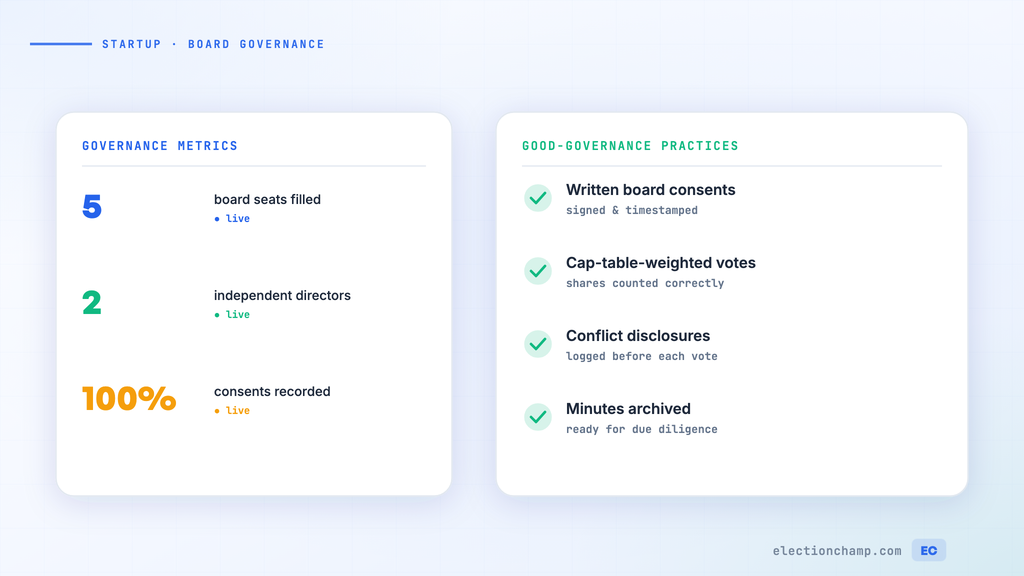
- Complete records: Can you produce board consents for every major decision? Missing records are a red flag in due diligence.
- Proper authorization: Were equity grants properly approved by the board? Unauthorized issuances create legal liability.
- Regular cadence: Does the board meet or act regularly, or is governance only reactive?
- Professional process: Is there a clear decision-making framework, or is everything ad hoc?
Getting Started: Governance for Busy Founders
You don’t need a corporate secretary or a governance consultant to start doing this right:
- Use ElectionChamp for formal board votes — it takes 10 minutes to set up and produces a complete record
- Set a quarterly rhythm for board decisions: approve the budget, ratify equity grants, review strategy
- Keep a board resolution log: a simple document listing every formal action, date, and vote result
- Store everything in one place: corporate folder in your cloud drive with bylaws, consents, meeting minutes, and election records
The startup that establishes clean governance early avoids expensive legal cleanup later — and signals to investors that the founders take their fiduciary responsibilities seriously.
Planning your next vote? Read about online voting for businesses and polls, surveys, and motions, or see pricing: free up to 20 voters, $10 up to 200, then $0.05 per voter.