ElectionChamp
The Promise and the Reality
Few technology topics generate as much enthusiasm — and misunderstanding — as blockchain voting. Proponents argue that blockchain’s decentralized, immutable ledger could make elections transparent, tamper-proof, and verifiable. Critics argue that blockchain introduces complexity, cost, and new security risks without solving the actual problems that matter in organizational voting.
The truth, as usual, lies in the nuance. This analysis examines what blockchain can and cannot do for online voting, helping you make an informed decision for your organization.
What Blockchain Promises for Voting
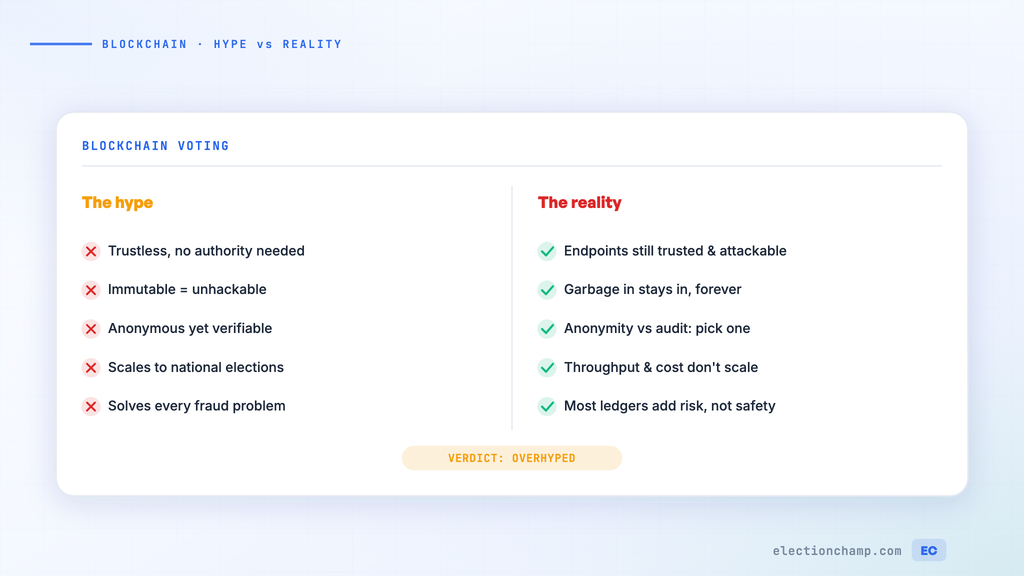
- Immutability: Once a vote is recorded on the blockchain, it cannot be altered or deleted
- Transparency: The blockchain ledger can be publicly auditable without revealing individual votes
- Decentralization: No single entity controls the voting infrastructure
- Verifiability: Voters could theoretically verify that their vote was recorded correctly
- Resistance to tampering: Altering results would require controlling a majority of the network
The Anonymity Paradox
Blockchain is designed for transparency and traceability — the opposite of what secret ballot voting requires. Creating a system where votes are both verifiable (blockchain’s strength) and anonymous (democracy’s requirement) is technically complex and unsolved at scale. Every proposed solution involves trade-offs that either weaken anonymity or weaken verifiability.
Complexity and Cost
- Blockchain infrastructure requires specialized knowledge to deploy and maintain
- Transaction costs (gas fees on public blockchains) add per-vote expenses that don’t exist with traditional online voting
- The learning curve for administrators and voters is significantly higher than standard web-based voting
The “Last Mile” Problem
Blockchain secures the vote after it’s cast, but it doesn’t solve the most critical vulnerability: what happens before the vote reaches the blockchain. If a voter’s device is compromised, or if someone coerces a voter, the blockchain faithfully records a compromised or coerced vote as immutable truth.
Scalability and Speed
- Public blockchains have transaction throughput limitations — during peak voting periods, confirmation times can spike
- For an organization running a 3-day election with 500 voters, blockchain infrastructure is dramatically overengineered
- The vast majority of organizational elections don’t need decentralized infrastructure — they need fast, secure, well-documented voting
What Actually Matters for Organizational Election Security
|
Security Need |
Blockchain Solution |
Proven Alternative |
|
Prevent duplicate voting |
Blockchain address per voter |
Unique single-use voter keys (simpler, equally effective) |
|
Anonymous ballots |
Complex cryptographic schemes (partially solved) |
Architectural separation of voter identity and ballot data (proven) |
|
Tamper-proof results |
Immutable ledger |
Automated counting + cryptographic audit trail + admin-proof architecture |
|
Verifiable process |
Public ledger examination |
Downloadable audit logs, results CSV, and independent verification |
|
Accessible to all voters |
Requires wallet setup, blockchain understanding |
Click a link, enter a key, vote in a browser |
Pilot Projects: What We’ve Learned
Several pilot projects have tested blockchain voting in real elections:
- West Virginia (2018): Used a blockchain-based app for overseas military voters. The project was later discontinued amid security concerns identified by researchers.
- Moscow (2019): Implemented blockchain voting for city council elections. Researchers identified vulnerabilities in the encryption scheme.
- Various universities: Several have used blockchain for student government elections, with mixed results on usability and participation.
The consistent finding: blockchain adds technical complexity that creates new attack surfaces without eliminating existing ones. The practical security improvements are marginal compared to well-implemented traditional encryption and authentication.
When Blockchain Might Make Sense
Blockchain could potentially add value in very specific scenarios:
- Extremely high-stakes elections where multiple independent parties need to verify results without trusting a central authority
- Elections across organizations that don’t trust each other’s infrastructure (inter-organizational voting)
- Situations where end-to-end verifiability is legally required and no central authority is acceptable
For the vast majority of organizational elections — HOA board votes, nonprofit elections, union officer elections, school council elections — blockchain is a solution in search of a problem. Proven encryption, unique voter keys, and comprehensive audit trails deliver superior security with far less complexity.
Our Approach: Proven Security Without the Hype
ElectionChamp uses established, industry-standard security technologies: AES-256 encryption, SSL/TLS connections, unique 16-digit voter keys, architectural ballot anonymization, and comprehensive audit trails. These technologies have been securing sensitive transactions — banking, healthcare, government — for decades. They work, they’re well-understood, and they don’t require voters to learn blockchain technology to exercise their right to vote.
Planning your next vote? Read about secure online voting and audit trail, or see pricing: free up to 20 voters, $10 up to 200, then $0.05 per voter.