ElectionChamp
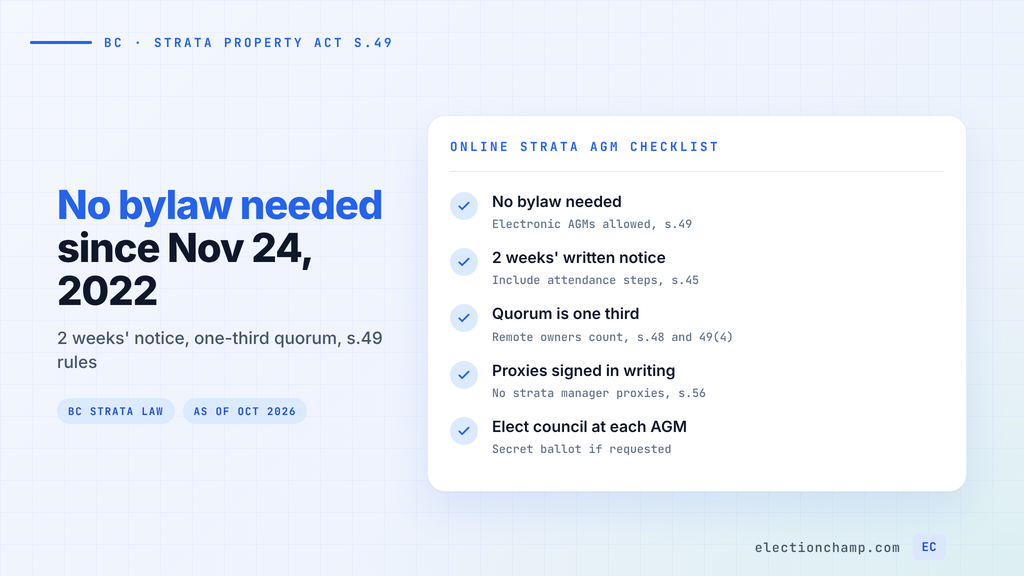
Short answer: Yes. Since November 24, 2022, a BC strata corporation can hold its AGM or SGM in person, electronically, or as a hybrid without passing a bylaw. Section 49 of the Strata Property Act sets three conditions: the notice must include attendance instructions, everyone must be able to communicate, and the chair must be able to identify eligible voters. Electronic attendees count as present in person, including for quorum.
This guide covers each rule your strata council needs before an online AGM. Section numbers come from the Strata Property Act on BC Laws (consolidation current to December 9, 2025) and the province’s strata voting process page. Your filed bylaws can add rules, so confirm each step with your declaration, bylaws, and counsel.
Can a BC Strata Hold an Electronic AGM?
Yes, and no bylaw is needed. The province’s guidance says strata corporations can hold annual and special general meetings in person, electronically, or as a hybrid, with no bylaw required, since November 24, 2022.
That date matters because the rules changed twice. In April 2020, Ministerial Order M114 let stratas meet electronically during COVID-19 as a temporary measure. Those temporary rules later expired, and stratas that wanted to keep meeting online had to rely on a bylaw. Bill 44, the Building and Strata Statutes Amendment Act, 2022, replaced section 49 and made electronic attendance permanent on Royal Assent.
The Three Conditions in Section 49
Under section 49(1) and (2), a strata corporation may provide for attendance and voting by telephone or other electronic means if:
- The section 45 notice includes instructions for attending by electronic means (s.49(2)(a)).
- The method lets all persons attending communicate with each other (s.49(2)(b)).
- The method lets the chair identify whether a person attending electronically is an eligible voter (s.49(2)(c)).
Section 49(4) deems an electronic attendee present in person at the meeting. Section 49(3) adds that, despite the bylaws, an electronic attendee does not need a voting card and is neither entitled nor required to vote by secret ballot.
The communication condition shapes how you set up the meeting. A ballot link on its own does not let owners speak to each other. Run the discussion on a video or phone call, and use an online ballot for the vote itself.
Voting Without a Meeting
A strata cannot replace its AGM with an online ballot alone. The exception is section 44: a meeting is not required if all eligible voters waive the meeting in writing and consent in writing to the resolution. Unanimity is hard to reach in most buildings, so plan on a meeting.
BC Strata Meeting and Voting Rules at a Glance
The table lists the default rules. Where the Act lets bylaws vary a rule, the table says so.
| Rule | What the Act says | Section |
|---|---|---|
| Electronic attendance | Allowed with notice instructions, two-way communication, and voter identification by the chair; no bylaw needed | s.49 |
| Notice of AGM or SGM | At least 2 weeks’ written notice; 4 weeks for a winding-up resolution | s.45(1), (1.1) |
| Notice contents | Matters to be voted on, wording of any 3/4, 80%, or unanimous resolution, date, time, place, electronic instructions | s.45(3) |
| AGM notice extras | Proposed budget and financial statement | s.45(4) |
| Quorum | Eligible voters holding 1/3 of the votes (2/3 if fewer than 4 lots or owners); bylaws can vary | s.48 |
| Default vote threshold | Majority vote unless the Act or regulations require otherwise | s.50 |
| 3/4 vote | At least 3/4 of votes cast by eligible voters present in person or by proxy, abstentions excluded | s.1 |
| Votes per lot | One vote per strata lot unless a Schedule of Voting Rights says otherwise | s.53(1) |
| Proxies | In writing, signed, revocable at any time; general or specific | s.56 |
| Council election | Eligible voters must elect a council at each AGM | s.25 |
| Special meeting demand | Holders of at least 20% of the votes can demand an SGM; held within 4 weeks | s.43 |
Strata AGM Electronic Meeting Notice and Quorum
Section 45(1) requires at least 2 weeks’ written notice to every owner. It also goes to mortgagees who filed a section 60 request and to tenants who hold an assigned voting right. Section 45(3)(c) requires the electronic attendance instructions inside the notice itself, so a link sent later does not satisfy the rule.
For an AGM, the notice must also carry the budget and financial statement under section 45(4). Any resolution needing a 3/4 vote, an 80% vote, or a unanimous vote must appear with its proposed wording under section 45(3)(a).
Quorum under section 48 is eligible voters holding one third of the strata corporation’s votes, present in person or by proxy. If quorum is not reached within half an hour, the meeting is adjourned to the same time the following week. The eligible voters present at that adjourned meeting form the quorum. Your bylaws can change these defaults.
Electronic attendance often helps with quorum because remote owners count as present under section 49(4). Our guide on reaching quorum faster with online voting covers reminder timing.
Strata Proxy Rules in BC
Section 56 lets eligible voters vote in person or by proxy. A proxy appointment must be in writing and signed by the person appointing the proxy. It can be general, or limited to a specific meeting or resolution, and it can be revoked at any time.
Section 56(3) limits who can act as a proxy. Employees of the strata corporation and strata management providers may act only if the regulations permit. The province’s voting page states plainly that a proxy cannot be the strata manager or a strata employee. Under section 56(4), the proxy stands in the place of the person who appointed them, unless the appointment limits their authority.
Proxies work the same way at an electronic meeting. A proxy holder who attends by video counts as present and votes for each lot they represent. Collect proxy forms before the meeting so the chair can confirm them when identifying eligible voters. For forms and tracking, see our proxy voting guide.
Who Counts as an Eligible Voter
Section 54 makes the owner the voter unless a tenant or mortgagee holds the right instead. A mortgagee can vote only on matters affecting its security, and only after written notice at least 3 days before the meeting. The provincial page notes that co-owners of one lot share a single vote, and the chair discounts that vote if they cannot agree. Section 53(2) also lets a bylaw suspend a lot’s vote where the strata can register a lien against it.
Council Elections, Secret Ballots, and 3/4 Votes
Section 25 requires the eligible voters present in person or by proxy to elect a strata council at each AGM. Section 28(1) sets who can stand: owners, individuals representing corporate owners, and tenants assigned the right to stand. A bylaw can add other classes of people.
Under the Standard Bylaws (section 27), votes are normally decided by a show of voting cards. Any eligible voter can request a precise count, and the chair then picks the method. If an eligible voter requests a secret ballot, the vote must be held by secret ballot. That applies to council elections and to any other vote.
Hybrid meetings create a gap here. Section 49(3)(b) says electronic attendees are neither entitled nor required to vote by secret ballot. So a secret ballot request can leave in-room owners voting privately while remote owners vote in the open. One way to close that gap is to put every voter, in the room or remote, on the same anonymous online ballot. Confirm that approach with your bylaws and counsel first.
Bylaw changes need a 3/4 vote, per the provincial page. Under the section 1 definition, abstentions are excluded and only votes cast by eligible voters present in person or by proxy are counted. Budgets and strata fees pass by majority vote.
How to Run an Online Strata AGM: Step by Step
This sequence fits a typical strata AGM with a council election and one or two resolutions.
- Check your filed bylaws for quorum changes, proxy limits, and any electronic attendance rules your strata adopted earlier.
- Pick the meeting platform (video or phone) and the ballot tool. Test both with a council member who is not tech-savvy.
- Build the voter list: one entry per strata lot, using the owner or the person holding the voting right. Remove lots suspended under a section 53 bylaw.
- Send written notice at least 2 weeks ahead, with the budget, financial statement, resolution wording, and electronic attendance instructions.
- Collect signed proxies before the meeting and record which lots each proxy holder represents.
- At the meeting, the chair confirms quorum, identifies eligible voters, and opens discussion on each item.
- Open the ballot for each vote, close it, and read the results into the record.
- Record the results in the minutes and file them with the meeting records.
ElectionChamp handles the ballot step. Each strata lot gets a single-use 16-character voter key by email, SMS, or a printed key for owners in the room. Ballots are anonymous: the council can see which lots have voted, never how they voted. A proxy holder can receive the key for each lot they represent, and a weight column handles a Schedule of Voting Rights that uses whole numbers. Results appear instantly when voting closes and export as CSV. Our page on strata and condo online voting shows the setup, and our AGM online voting guide covers timing.
Cost is per election. A strata with 21 to 200 lots pays a flat US$10, and stratas with 20 or fewer lots pay nothing.
Records to Keep After the Vote
Section 35(1) requires minutes of annual and special general meetings, including the results of any votes. Section 35(2) also requires the strata to retain waivers and consents under sections 41, 44, and 45. The province’s record keeping page says general meeting minutes must be kept for six years, and correspondence for two.
The Act does not list proxies or ballots separately in section 35. Keeping signed proxies, the voter list, and the exported results with the minutes gives the strata a clear answer if a vote is challenged. Owners can request most records within two weeks, per the provincial page.
Disputes about meetings and votes can go to the Civil Resolution Tribunal, BC’s online tribunal for strata disputes. A complete record of notice, quorum, eligible voters, and results is the strata’s best defence there.
Frequently Asked Questions
Does a BC strata need a bylaw to hold an electronic AGM?
No. Since November 24, 2022, section 49 of the Strata Property Act lets a strata corporation offer electronic attendance and voting at AGMs and SGMs without a bylaw. The notice must include instructions, attendees must be able to communicate, and the chair must be able to identify eligible voters.
Do owners attending electronically count toward quorum?
Yes. Section 49(4) deems an electronic attendee present in person at the meeting. Quorum under section 48 is eligible voters holding one third of the votes, unless your bylaws set a different figure.
Can a strata manager hold a proxy in BC?
No. Section 56(3) lets strata employees and strata management providers act as proxies only where the regulations permit. The BC government’s voting guidance says a proxy cannot be the strata manager or a strata employee.
Can a strata council election be held by secret ballot online?
The Standard Bylaws require a secret ballot when an eligible voter requests one, but section 49(3) says electronic attendees are neither entitled nor required to vote by secret ballot. A strata can choose to give every voter the same anonymous online ballot. Confirm this with your bylaws and counsel.
Planning your next vote? Read about strata and condo online voting and council elections, or see pricing: free up to 20 voters, US$10 up to 200, then US$0.05 per voter.